
Buy it here:
Dalkey Archive, Amazon, Bookshop
Synopsis:
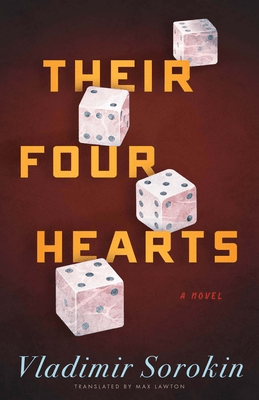
In many respects, Their Four Hearts is a book of endings and final things. Vladimir Sorokin wrote it in the year the Soviet Union collapsed and then didn’t write fiction for ten years after completing it–his next book being the infamous Blue Lard, which he wrote in 1998. Without exaggerating too much, one might call it the last book of the Russian twentieth century and Blue Lard the first book of the Russian twenty-first century. It is a novel about the failure of the Soviet Union, about its metaphysical designs, and about the violence it produced, but presented as God might see it or Bataille might write it.
Their Four Hearts follows the violent and nonsensical missions carried out by a group of four characters who represent Socialist Realist archetypes: Seryozha, a naive and optimistic young boy; Olga, a dedicated female athlete; Shtaube, a wise old man; and Rebrov, a factory worker and a Stakhanovite embodying Soviet manhood. However, the degradation inflicted upon them is hardly a Socialist Realist trope. Are the acts of violence they carry out a more realistic vision of what the Soviet Union forced its “heroes” to live out? A corporealization and desacralization of self-sacrificing acts of Soviet heroism? How the Soviet Union truly looked if you were to strip away the ideological infrastructure? As we see in the long monologues Shtaube performs for his companions–some of which are scatological nonsense and some of which are accurate reproductions of Soviet language–Sorokin is interested in burrowing down to the libidinal impulses that fuel a totalitarian system and forcing the reader to take part in them in a way that isn’t entirely devoid of aesthetic pleasure.
As presented alongside Greg Klassen’s brilliant charcoal illustrations, which have been compared to the work of Bruno Schulz by Alexander Genis and the work of Ralph Steadman as filtered through Francis Bacon by several gallerists, this angular work of fiction becomes a scatological storybook-world that the reader is dared to immerse themselves in.
Review:
When I reviewed Vladimir Sorokin’s The Blizzard in 2016, I started the review with the sentence: “Vladimir Sorokin is nuts.” I do not remember everything about The Blizzard, but I do know that this level of nuttiness in The Blizzard does not compare to Their Four Hearts. Nuts is not even where I would begin to describe what Sorokin does in this novel.
The story centers around four characters. They could be spies or terrorists or working for the government or working against the government. I think that at certain points, all of these things are true. These four characters have missions they carry out, missions that make no sense, looking for information that makes even less sense. All that we know is that these missions are violent, disgusting, and brutal. Deaths are horrific. The treatment of women is misogynistic and grotesque. There are moments that rival the best extreme horror novels, moments that make you cringe while you read and contemplate your life. Some of the reviews have the readers throwing away the book instead of finishing it. Those who quit early should not be alarmed that Their Four Hearts does to get any better and does not get any easier to read.
So why do I like this novel so much? This is a question that cannot really be explained. The entire novel is more about the four characters than the nonsense that surrounds them. These are archetypes of characters in 1990s Russian society, which was rapidly changing at the time. Even though each of the characters are horrible people in their own ways, there seems to be an earnestness in the way they feel about the importance of the missions that they are carrying out. Missions that seemingly have no meaning or purpose. In the end, I like the feeling of the book and the brutalness of the action. The four main characters have to contribute to this ugliness of fit in because the final mission might be one of sheer beauty.
Vladimir Sorokin’s next novel, Blue Lard, led to public demonstrations and calls for his execution as a pornographer, but I am certain that the reason why Blue Lard caused this reaction is because the people just did not read Their Four Hearts. I enjoyed it, but it is also something I would not want my mother to catch me reading.


 ghostvillehero