
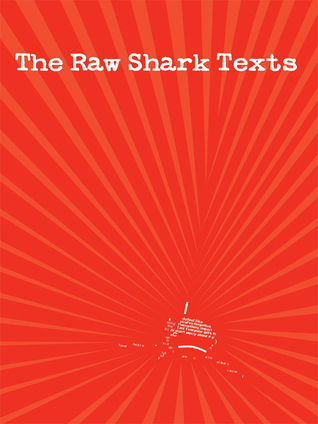
Buy it here:
Synopsis:
Eric Sanderson wakes up in a house one day with no idea who or where he is. A note instructs him to see a Dr. Randle immediately, who informs him that he is undergoing yet another episode of acute memory loss that is a symptom of his severe dissociative disorder. Eric’s been in Dr. Randle’s care for two years — since the tragic death of his great love, Clio, while the two vacationed in the Greek islands.
But there may be more to the story, or it may be a different story altogether. As Eric begins to examine letters and papers left in the house by “the first Eric Sanderson,” a staggeringly different explanation for what is happening to Eric emerges, and he and the reader embark on a quest to recover the truth and escape the remorseless predatory forces that threatens to devour him.
The Raw Shark Texts is a kaleidoscopic novel about the magnitude of love and the devastating effect of losing that love. It will dazzle you, it will move you, and will leave an indelible imprint like nothing you have read in a long time.
Review:
The Raw Shark Texts is my favorite type of novel, one that people have really strong feelings about. I would always rather read a novel with an average Goodreads score of 3, with half of the reviews being one star and half of the reviews being five stars, than read a book with an average score of 3 stars with all of the reviews being three stars. These polarizing books usually end up becoming some of my absolute favorites. There are enough poor, one star reviews of The Raw Shark Texts that I knew I would probably like it. This is not a typical book, a typical structure, or a novel that gives all of the answers.
Each of the four parts of the novel are distinctive from the last. The first part is a man, Eric Sanderson, waking up and not having any memory. He spends his time trying to get his bearings of who he is and his memory. He is getting letters, but he does not open any of them, just throws them into a kitchen cabinet and ignores them. The second part is about the shark that starts to stalk him, attracted to him because is attracted to his words, his language, his life, and the history that he does not completely remember. He starts to open the letters from the previous version of Eric Sanderson, and there are a few things that help him remember who he used to be, but most of the letters are about how to protect himself. Part three is about trying to find help with getting rid of this stalking shark because he is not going to live in peace as long as a shark is stalking him in his periphery, a road adventure leading to new characters that might help him or get him killed, and part four is pretty much a rewrite of the climatic scenes in the original Jaws, the small group of people going on a shark hunt. There are also many elements that make this feel like a loose retelling of The Wizard of Oz, with Sanderson convinced that if he finds the Wizard, Dr. Fidorous, he will have all of the answers to help defeat the text shark and get him home. And of course there is the mysterious girl who shows up in the middle of the adventure to guide him to Dr. Fidorous and a love who had died in an accident, Clio, the two girls possibly being the same person. There are many aspects to this novel that mosaic together the entire story, and in the end, in the last few pages, there is another light bulb that is turned on that will make you rethink everything that you have read.
I enjoyed The Raw Shark Texts and found many of the puzzles, directions, misdirections, and creativity impressive and entertaining. Many people talk about this book in the same conversation as House of Leaves by Mark Z. Danielewski, but The Raw Shark Texts is nowhere near as dense and opaque, a much more accessible version of this type of novel. There are some things that are purposefully left up to question and interpretation. Considering The Raw Shark Texts is also a pun of the Rorschach Tests, a psychological test where inkblots are shown to a person and they are to give their interpretation of what they see, it makes complete sense that The Raw Shark Texts is open to the reader’s interpretation of what they see. This is a strange novel, with a weird, incredibly creative plot, but it is also one of those books that if someone is new to reading abstract and challenging literature, it would be the first novel that I recommend because it is also very easy to read and enjoy. I do also recommend a physical version of this novel, because how else are you going to get the text shark flip book animation? This also proves my theory that I should always read books with polarizing views because I tend to really enjoy them.



 ghostvillehero
