
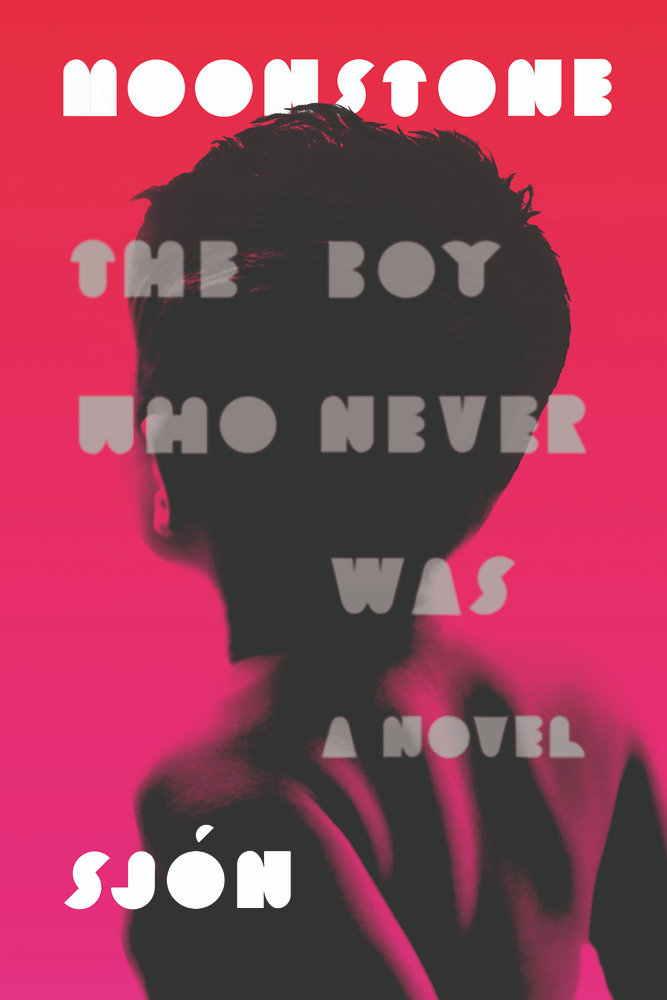
Buy it here:
Synopsis:
The mind-bending miniature historical epic is Sjón’s specialty, and Moonstone: The Boy Who Never Was is no exception. But it is also Sjón’s most realistic, accessible, and heartfelt work yet. It is the story of a young man on the fringes of a society that is itself at the fringes of the world–at what seems like history’s most tumultuous, perhaps ultimate moment.
Máni Steinn is queer in a society in which the idea of homosexuality is beyond the furthest extreme. His city, Reykjavik in 1918, is homogeneous and isolated and seems entirely defenseless against the Spanish flu, which has already torn through Europe, Asia, and North America and is now lapping up on Iceland’s shores. And if the flu doesn’t do it, there’s always the threat that war will spread all the way north. And yet the outside world has also brought Icelanders cinema! And there’s nothing like a dark, silent room with a film from Europe flickering on the screen to help you escape from the overwhelming threats–and adventures–of the night, to transport you, to make you feel like everything is going to be all right. For Máni Steinn, the question is whether, at Reykjavik’s darkest hour, he should retreat all the way into this imaginary world, or if he should engage with the society that has so soundly rejected him.
Review:
Sjón is a Icelandic writer who has written songs with Bjork (including the Academy Award nominated song for the Lars Von Trier film Dancer in the Dark), written screenplays (most notably Lamb and the Robert Egger’s collaboration, The Northman), and over a dozen fiction and poetry books. I have read and reviewed CoDex 1962 and Red Milk, and when I stumble on any of his books in the bookstore, I pick it up.
What Sjon does in Moonstone: The Boy that Never Was is a huge reason why I seek out his work. Máni Steinn is an orphan that lives in an attic with a distant relative. He is obsessed with movies, watching every film shown at both the old cinema and the new cinema in Reykjavik. He is obsessed with a girl who drives an old Indian motorcycle around town, and he makes money by having sexual encounters with men (one is an English speaking man who’s pronunciation of Mani Stein sounds like Moonstone). The story takes place during a few months in 1918, when the Spanish Flu rips through the town and changes everything. Máni observes the town getting more and more sick, the cinema emptying out, his dates disappearing, and the amount of the dead piling up. He almost becomes one of the number himself. Sjón’s writing and Victoria Cribb’s translation brings the reader into this dark world, making us part of the dying city. The writing is crisp and sharp, but the story is so bleak. We are transported into the middle of and Iceland that is cold and dying of sickness, and we can feel the fever, death, and sadness spreading through every house.
Nothing about this novel can change. It is rare to be so transported into a world so fleshed out by an author using so few words. The novel is less than 150 pages, and many of those pages are blank. For Sjón to write such a strong and powerful novel in such a small space really shows how good he is. Sjón is one of the best writers in the world, and Moonstone: The Boy Who Never Was is proof.


 ghostvillehero