
Buy it here:
Synopsis:
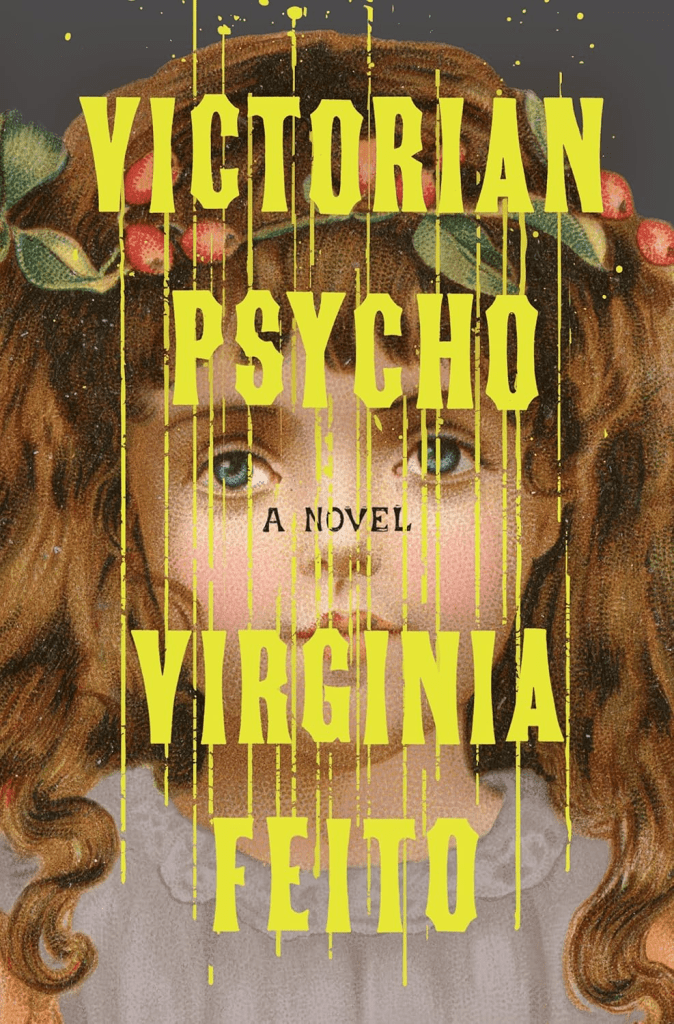
Winifred Notty arrives at Ensor House prepared to play the perfect Victorian governess. She’ll dutifully tutor her charges, Drusilla and Andrew, tell them bedtime stories, and only joke about eating children. But the longer Winifred spends within the estate’s dreary confines and the more she learns of the perversions and pathetic preoccupations of the Pounds family, the more trouble she has sticking to her plan.
Whether creeping across the moonlit lawns in her undergarments or gently tormenting the house staff, Winifred struggles at every turn to stifle the horrid compulsions of her past until her chillingly dark imagination breaches the feeble boundary of reality on Christmas morning.
Wielding her signature sardonic wit and a penchant for the gorgeously macabre, Virginia Feito returns with a vengeance in Victorian Psycho.
Review:
Winifred Notty is the new governess for the Pound children, Andrew who is nine-years-old and his older sister Drusilla. They are to be taught their lessons, told stories, tucked into bed, and shown how to be children who are seen and not heard. The problem is that Mr. and Mrs. Pound do not know that they hired someone who plans to kill the whole family by Christmas morning. There are so many things that I enjoy about this book, and at a little under 200 pages, Victorian Psycho is a perfect story that really brings us to the Victorian era where the manor is cold and the people are colder.
Victorian Psycho echoes the other great novel about a sociopath killer, American Psycho by Bret Easton Ellis. Both of the main characters, Miss Notty and Patrick Bateman feel invisible in a society that has more money than intelligence. Both characters say things under their breath and do things without raising suspicion, mostly because everyone they encounter is too busy with their own hopes of prestige and influence. So they are able to push the boundaries of the sick and the depraved imagination, and nobody really knows what is happening because they are too blinded by the their own life and how they are perceived by others. The difference between Bateman and Notty is that Notty has the other hired help in the house on her level, watching her, and seeing her doing the odd things that Notty thinks she is getting away with, and knowing she is dangerous. Living in Ensor House, the other house staff is watching her all of the time, so people know what she is doing and are frightened of her, but they do not have the authority to stop her. They have to watch her in horror. Bateman spends most of his story alone with his thoughts and his actions, killing people in his apartment and not getting caught, whereas Notty always has someone in the house with her, whether it be the children she is supposed to be teaching or the help who keep Ensor House running.
Despite the atrociousness Winifred Notty, I enjoy her as a character. I like her depravity, her sheer unhappiness, and her disgust for society around her. And I like seeing society around her portrayed in a way that she is justified in her disgust. One of the best examples is when some houseguests mention needing to go home because there is a chimney sweep stuck in their chimney. The true history of chimney sweeps in Victorian times is horrible. They were young, scrawny boys because the chimneys were so small, some of them were as young as four and six years old. They climbed up the narrow chimneys, and they got stuck often. One of the things homeowners did when the young sweeps got stuck was light a fire in the hearth (also the origins the expression “light a fire under someone’s ass”). Many tried to scramble further up the chimney, got even more stuck and died. Sometimes the chimneys would have to be taken completely apart to get the dead kid out. The novel mentions this in passing, but it is because they finally made laws where chimney sweeps had to be at least twelve, so they got stuck more often, and this was seen as a terrible idea for the industry. The Victorian age was not nice to children, and those without money who grew up working all of their lives, who actually survived to adulthood had an understandable bitterness toward society. It is no wonder that Miss Winifred Notty ended up the way that she is, and the depiction of her and society that made her in Victorian Psycho is pitch perfect.


 ghostvillehero