
Buy it here:
Amazon, Booshop
Synopsis:
A deeply moving family story unfolding in richly evocative prose and a poetic portrayal of a town in decline during the final decades of the American century, Ashland is a book of metamorphoses—of the dance between permanence and transformation.
In Ashland, New Hampshire, Carolyn, born of a teenage pregnancy, grows up alongside her mother Ellie, her aunt Jennie, and her cousins. Ashland is the type of place that most people plan to leave, but few do. Beauty can be found in small things—the trees in the wind, the sky’s particular shade of blue, a swim in the river, love, and family. But life can often be unforgiving and solace hard to come by. Carolyn reconciles the losses in her own life with an education at Plymouth State, the local university, and then by capturing in words her world and the people who inhabit it.
Recalling the novels of Richard Russo, Paul Harding, Marilynne Robinson, and Elizabeth Strout, Ashland is a novel of debut great intensity and poetry told in the voices of many vivid characters and, through them, in the voice of Ashland itself.
Review:
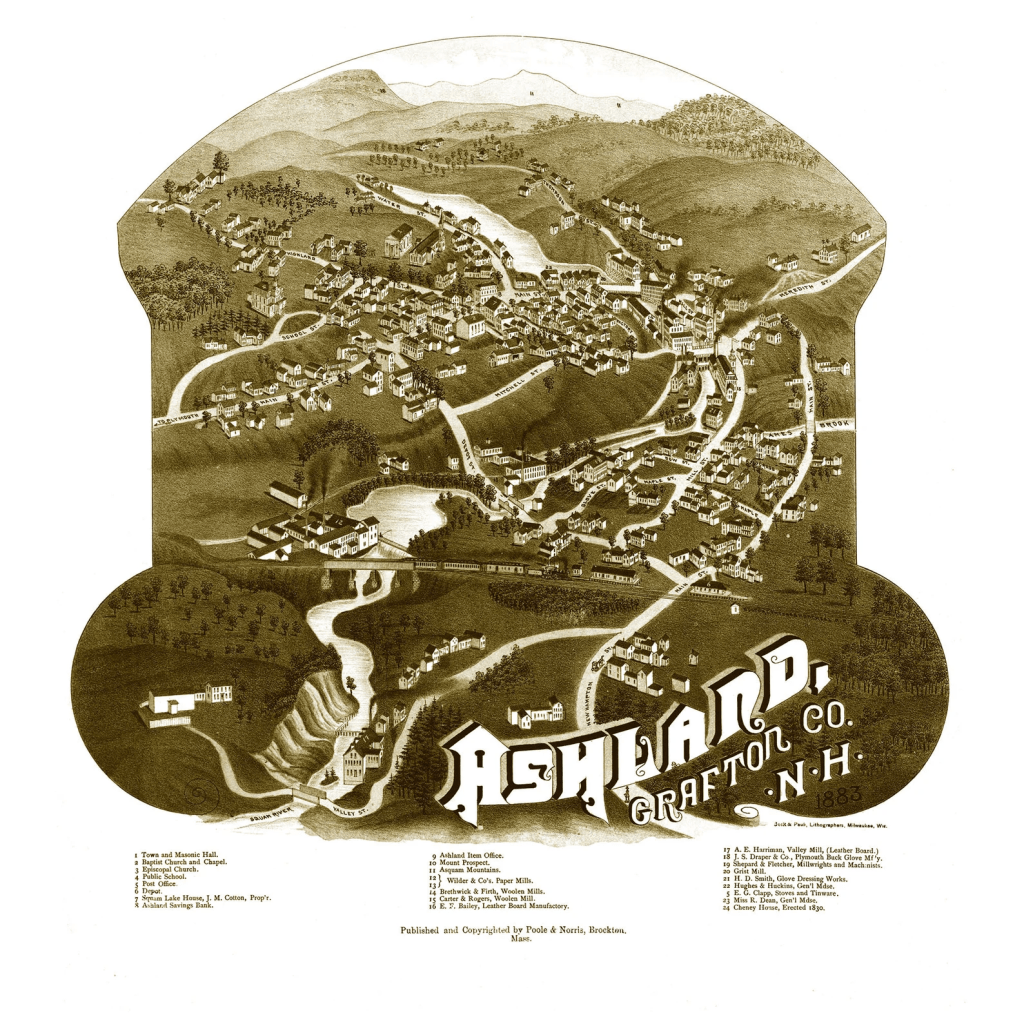
The main character in Dan Simon’s novel, Ashland is the town of Ashland. New Hampshire. Ashland is a town with a population of less than 2000 since it’s inception in 1868. The town lies in a triangle wedged between the Pemigewasset River on the west and Little Squam Lake on the east. The town has a history of a sawmill and textile mill industry. During the time period of the novel, 1970s-1990s, there are changes happening in the town’s job market, with downsizing of the L.W. Packard textile mill, (which eventually closed for good in 2002). The story of Ashland is told through several narrators, the main one being Carolyn, born in 1972 when her mother is seventeen, and how she sees Ashland and herself as part of the world. She lives with her mother, her cousin who is a few months younger than her, and with her aunt who had her cousin at fourteen. Carolyn recounts her childhood, but there is not much about her father, who is long gone, or how her mother and aunt had children too young. She focuses more on the way that she interacts with nature and how Ashland might be a place that people want to leave, but she sees it as the only place that she can live.
Most of Ashland is an exploration of nature. The town, but also the rivers, the lakes, and the mountains that surround the area. The people who are not born there are people who think that it is paradise, a place that should not even exist. The teacher at Plymouth State, where Carolyn and her mother eventually attend at separate times, says that he has fallen in love with the state and the area because of the soil, the mountains and the beauty. He is in awe that the mountains are close enough that his students can attend morning classes, climb one of the forty-one 40,000 feet elevation mountain peaks in the area, and be back home in the evening to study. Every person in Ashland who narrates feels that they are living in a place that is special, and even though bad things happen to the people who inhabit the town, job loss, teenage pregnancy, long time sickness, and even death, there is a sense that everyone is blessed by being in this town and in this area.
There are many different voices and narrators telling the story, but the main one is Carolyn as a child and teenager. This voice was kind of confusing to me at first, due to receiving texture hints that there are major things happening between the adults in her life, but she is focusing on nature and the rivers and the way that the wind is blowing in the trees. I thought it was strange that all of the adults seemed to get along in a beautiful way from her perspective, even when they are ex-lovers, fathers of their children, and people who should not genuinely get along. I finally realized that with this being told mostly through the eyes of a young girl, the adults are being nice to one another in front of her so that she does not recognize some of the turmoil around her. This little quirk to the narrative makes me think that the story is not about the truth, not even really about Carolyn, her family, and her neighbors, but about growing up in a small town in the middle of the mountains and forest, and how this can overshadow anything bad and hurtful.
Ashland is a meditation on nature and place more than it is about story and characters. There is very little of the appeal of other small town novels like The Heart is a Lonely Hunter or To Kill A Mockingbird because those are instances of characters driving the story of a small town. Ashland is more like a small town driving the characters. Those who were born in Ashland think about leaving but do not really want leave this land, and the people who have move there feel like they have been dropped into the lap of God. This is a love letter to growing up, nature, and to Ashland, New Hampshire and the surrounding area.
I received an ARC of Ashland through the publisher, Europa Editions, in exchange for an honest review.


 ghostvillehero