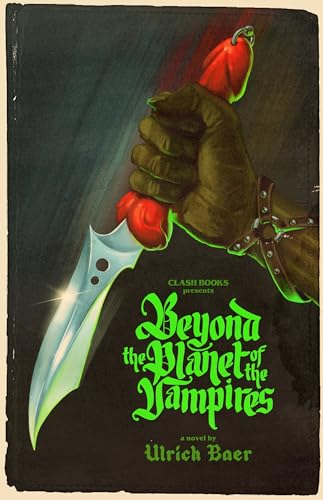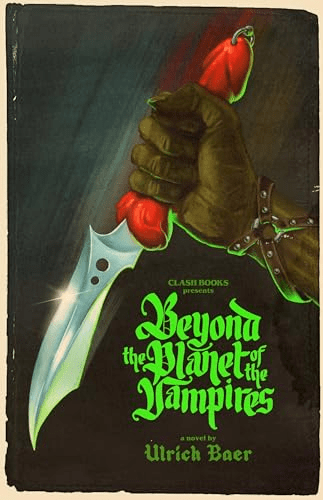
Buy it here:
Synopsis:
A speculative avant-garde queer horror novel that reads like an erotic vampiric nightmare directed by Jodorowsky playing at a ’50s drive-in.
Beyond the Planet of the Vampires is a gay pulp horror novel of chance. The narrative erratically loses and regains consciousness during an apocalyptic space invasion of psychic vampires, reaching across intergalactic fathoms in search of future victims.
Smoldering in a social alienation reminiscent of Genet’s outlaw anti-heroes, Baer’s novel screams with Joycean word play in an entirely new and unique idiom, where theories of Kant are situated with reckonings of identity and postulations on the nature of evil.
On each page, Ulrich Baer creates an enigmatic performance of both philosophical and queer thought, exercised through the rich aesthetic experience of a retro horror film. Beyond the Planet of the Vampires redefines avant-garde in a relentless, generation-defining voice.
Review:
I am a big champion of art that is not easy. Though it is definitely okay to like the type of music, books, and films that you like, it is also important to sometimes stretch beyond normal experiences. Sticking with that musical album you do not understand or rewatching the movie that makes no sense, or in the case of Beyond the Planet of the Vampires, reading something that relies on feeling morning that narrative, it makes you stretch and grow as a consumer of art and eventually an artist. Beyond the Planet of the Vampires is billed as many things. Avant-garde. Queer Horror. Joycean. A B-movie nightmare. In his blurb, Laird Hunt calls it, “Think Pale Celan and Buck Rogers meet up with the Beowulf poet in Nosferatu’s castle were Dennis Cooper is watching the Rocky Horror Picture Show and you’ll get some small sense of what goes down in Ulrich Baer’s excellent new novel.” None of these explanations are wrong but also none of them make any sense to me. The truth is that most of Beyond the Planet of the Vampires defies any explanation, that there is so much more focus on mood and vibe than character, setting, structure, and story, that what you feel while reading it is more important that what the novel is saying.
Ulrich Baer writes like he was an avid reader growing up, but the only book that he had access to was a dictionary. The vibe presented is structured with words you have to look up, combined words, words that are stylistically shortened (the Sonic Youth-esque “yr” being one throughout), and sentences that stop in the middle of a thought and never pick back up. The writing is something that makes sure that the reading is always in flux, always deconstructed, and never really what it seems. I was actually most of the way through before I realized that the first person narrator was the vampire. I also started re-reading it from the beginning as soon as I was done, thinking that there might be a little more clarity, but there is none. A work of fiction like this is completely up to the reader’s interpretation, and this is why the descriptions on the back are not necessarily wrong or misleading, but they are not the feelings I get out of it. I see this as more of an exploration of feelings about being alive in a world where you do not fit in than a vampire story.
The vampire comes from another world, crash lands on Earth so from the beginning, he feel like an outsider, someone who is exploring the world where he is completely alien (I have not read any of Baer’s other writing yet, but reading some of the descriptions, outer space and being an outsider on a planet seems to be a recurring theme). Having said this, the world where he crash lands might not even be Earth, that there are things that resemble Earth, like deserts and cliffs and a dungeon in a castle, and there is talk about Mississippi and the south, but this could all be illusion. The real setting is nowhere, like the Earth is so foreign that even the places that remind him of something else are not real places but just reminders. The search for lovers and victims by this vampire is definitely a search for queer love but in a trans male to male way. The vampire identifies as male but does not have the proper sex organs (which is pretty prevalent in vampire lore) so he uses tools to have sex with men, most of the time to feel like he can have a connection to humanity. Vampires do not need to have sex to survive, but this one seems to have a major interest in doing so. He likes the feeling of being called “my cute boy” and the post-coital joy that sex brings, feelings that he does not feel any other way. Baer uses the outer space vampire as a way to express existential feelings, the anxiety so high that even when he is somewhere he recognizes, it might not be real. He also uses the vampire imagery to explain the feeling of being a transperson, that not having the right organs to do the things that he wants to do is the same as not having them at all. In the end, the vampire does feel like a sympathetic character, one that is completely lost in a foreign world and trying to find a way to survive in a productive or at least enjoyable way.
Of course this is just my interpretation. The best thing about novels and art like this is that there are so many ways to look at it, and it is up to the reader to decide what they see and how they understand it. I always remember the David Lynch interview where he is asked to explain the meaning of his movie. His only answer is, “No.” It is up to us to make our own meanings, and though it is something that I do not want to do with every piece of art that I consume, it is something that exercises parts of my brain that need exercised sometimes. This is something that we should all do as readers or music listeners or filmgoers, especially if we make art as well. A book like Beyond the Planet of the Vampires is definitely a work that stretches your definitions of what reading means and what a novel can be. I am actually impressed that Clash Books has committed to publishing these types of books because most of them are very polarizing (the Goodreads for this novel has exactly 22% of 5 star reviews and 22% of 1 star reviews). I will definitely be paying closer attention to their catalog of books.


 ghostvillehero