
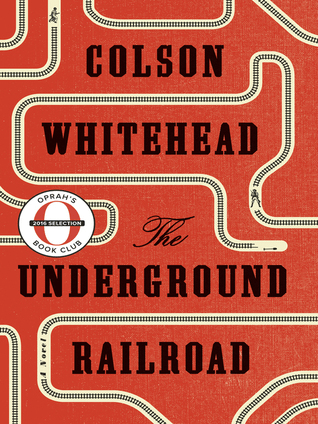
Buy it here:
Synopsis:
Cora is a slave on a cotton plantation in Georgia. Life is hell for all the slaves, but especially bad for Cora; an outcast even among her fellow Africans, she is coming into womanhood–where even greater pain awaits. When Caesar, a recent arrival from Virginia, tells her about the Underground Railroad, they decide to take a terrifying risk and escape. Matters do not go as planned–Cora kills a young white boy who tries to capture her. Though they manage to find a station and head north, they are being hunted.
In Whitehead’s ingenious conception, the Underground Railroad is no mere metaphor–engineers and conductors operate a secret network of tracks and tunnels beneath the Southern soil. Cora and Caesar’s first stop is South Carolina, in a city that initially seems like a haven. But the city’s placid surface masks an insidious scheme designed for its black denizens. And even worse: Ridgeway, the relentless slave catcher, is close on their heels. Forced to flee again, Cora embarks on a harrowing flight, state by state, seeking true freedom.
Like the protagonist of Gulliver’s Travels, Cora encounters different worlds at each stage of her journey–hers is an odyssey through time as well as space. As Whitehead brilliantly re-creates the unique terrors for black people in the pre-Civil War era, his narrative seamlessly weaves the saga of America from the brutal importation of Africans to the unfulfilled promises of the present day. The Underground Railroad is at once a kinetic adventure tale of one woman’s ferocious will to escape the horrors of bondage and a shattering, powerful meditation on the history we all share.
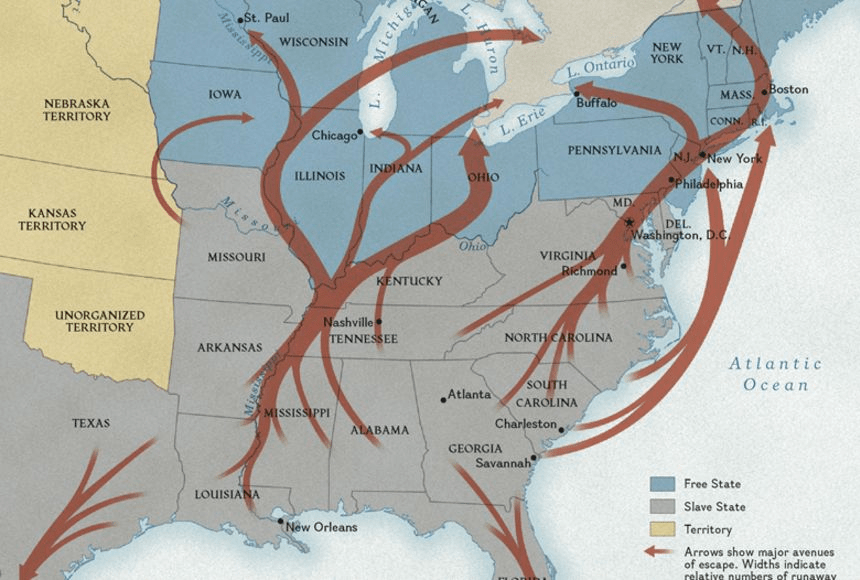
https://education.nationalgeographic.org/resource/undergroundrailroad/
Review:
Colson Whitehead has won several awards for his fiction, and The Underground Railroad is his biggest award winner. This novel won the Pulitzer Prize and The National Book Award (the only other novel to do this is The Shipping News by Annie Proulx), the Arthur C. Clarke Award, the 2016 Goodreads Reader’s Choice award, the Andrew Carnegie Medal of Excellence, and is placed #7 on the New York Times 100 Best Books of the 21st Century list. This is a novel I remember buying the day it was released, and it has sat on my shelf for almost a decade before I finally picked it up.
The main story is about Cora, a slave in Georgia who decides to run north to freedom. She becomes part of users of the Underground Railroad, which in Whitehead’s novel, is a literal railroad that runs through tunnels underground, with depots that are constantly getting shut down and arrival and departure times being sparse and inconsistent. At the Georgia depot, the boxcar she is loaded into seems to be close to falling apart. The next ride in South Carolina is even worse. The underground network seems to reflect the condition of the state where the depot and train is located, and while Cora runs into more and more danger on her journey, there are states where the Underground Railroad is not a reliable form of transportation at all, but it is her only chance for survival. The trials that Cora experiences are compounded by changing laws in each state, different attitudes toward people of color, free or enslaved, and the availability of help. Cora is also being hunted by Ridgeway, a slave catcher who is like Ahab in Moby Dick, willing to ruin his life and reputation with catching her, who’s only failure to catch a slave is Cora’s mother Mabel. Ridgeway, and who’s mania means Cora is never out of danger.
Any story of slavery is always a horrible story. With all of the disgusting, horrific true accounts that comes of out of American history, Whitehead does not have to even scratch the surface very deep for his novel to be gut-wrenching, devastating, and heartbreaking. Anyone who knows the conditions that slaves lived in while treated as property and farm equipment instead of humans, also knows that escape is the only true option. Cora runs through the swamp away from her owner, and as soon as she takes two steps off of the farm, the anxiety that the reader feels does not let up until the very end of the novel. These feelings, the horror of the plantation and the anxiety of the person getting chased and the punishment awaiting them, is not unique to The Underground Railroad and Cora’s story, but it definitely creates a certain backdrop while reading the novel.
With a background of anxiety to the danger and inevitable death of the main character, we also spend a great deal of time with the people who are around Cora, the network of people who are trying to help her, whether or not their intentions are pure or they have their own agenda. There are people in history, white people and freed slaves, that helped runaway slaves find their freedom, lawyers who tied up the courts, people who used cellars and attics to hide slaves on the route, and there were some churches that were very involved in helping the Underground Railroad. I remember visiting Detroit in the early 2000s and seeing The Second Baptist Church, a historical Underground Railroad landmark and a place that helped runaway slaves on their way into Canada. Historical sites are scattered across the country, but of course for everyone who was trying to help, there were many more trying to stop it, trying to capture them, trying to make sure that they stayed as property. The climate of all of this, the way that some people were helpful and some people were harmful, depending of if they saw slave as a person or as something to own, makes Cora’s escape, just like any escaped slave story, one that is filled with tension and danger from the first page to the last.
There are a few moments when Colson Whitehead pulls back from this tension and danger to bring up some more philosophical ideas. Like who is really free if there is hatred for another person in their heart? And one of the biggest freedoms that we have is reading and learning, and does that the people who do not do these things are people who are the true slaves? People who do not read for themselves are people who eventually no longer think for themselves. They become people fed information in a whatever way that suits the person giving the information. Slavery in a physical sense is horrific but so is slavery in a mental sense. The depth of this idea is not really explored enough but there are some examples of this in the book, particularly in the character of Homer, the young black boy who helps Ridgeway catch runaway slaves. There will always be people who do things against their own interests. Much of this is due to the lack of independent thought and critical thinking, things that are strengthened through acts of reading books and learning about the world. The Underground Railroad in this sense is every book, with depots at every library, every bookstore, every place where can. If we take the Underground Railroad, we can continue our journey through lives as free thinking people, or we can be people who do not even know they are enslaved to the rule and agendas of others.

 ghostvillehero