
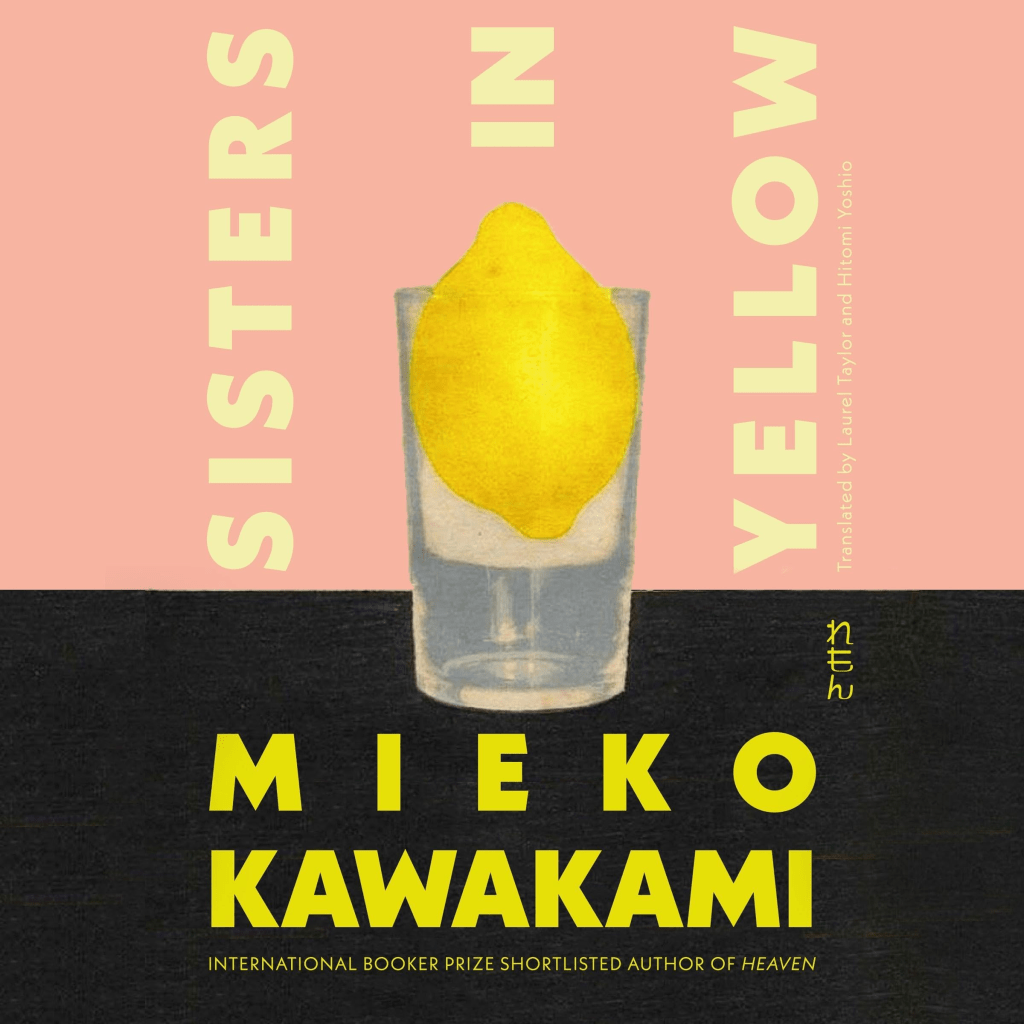
Buy it here:
Synopsis:
‘My heart felt very tender reading this. Astonishing Kawakami, as always‘ Frances Cha, author of If I Had Your Face
From the International Booker Prize-Shortlisted author of Heaven and Breasts and Eggs.
Hana has nothing but she’s hopeful. She’s fifteen years old. She lives in a tiny apartment in a suburb of Tokyo with her young mother, a hostess at a local dive bar. They have no money, no security. Then Kimiko appears.
Kimiko is older, a bright light in Hana’s dark world. Together they set up Lemon, a bar that, despite its shabby setting and seedy clientele, becomes a haven for Hana. Suddenly Hana has a job she loves, friends to share her days with, and the glittering promise of money. She feels like a normal girl. She feels invincible.
But in the narrow alleys of Sangenjaya, nothing is as it seems. Soon all of Hana’s hope, her optimism, and her drive, will be tested to the limit . . .
A story of enduring friendship and deep betrayal, Sisters in Yellow is a masterpiece of teenage dreams and adult cruelties that confirms Mieko Kawakami as one of the great writers of her generation.
Review:
The newest novel by Mieko Kawakami to be translated, Sisters in Yellow, starts with an older Hana poking around on the internet during 2020 lockdown and finding an article about one of her old friend, Kimiko Yoshikawa being arrested for blackmail, abduction, and battery of a woman over a 15-month period. This makes Hana think about when she knew Kimiko, in the late 90s, when she was still a teenager and Kimiko was in her late twenties/earlier thirties, opening a bar together and being roommates. The story is told in first person by Hana, and while Hana grows older and spends time with Kimiko, she meets two other friends, Ran Kato and Momoko Tamamori. The story is about teenage girls finding their footing in adulthood, and how their friendship fell apart.
The start of the novel is very interesting, but Meiko Kawakami spend too much time telling the full story of Hana in the 90s, about when she first meets Kimiko when she is fifteen. Hana looks up to Kimiko as a role model, and this is a consistency through the entire time that they know each other. The entire novel is about Hana growing up and seeing that the adults who she has around her to admire and emulate are people who are struggling, broken, and trying to figure out what they are doing too. The only thing that Hana really has that is consistent, her safety net, is the money she has saved, a little shoebox in the closet filled with paper bills squirrel away from various jobs. The problem is that this shoebox not only becomes the only thing that she can rely on, but she starts to sees more worth in working and filling up that shoebox that she sees in saving her friendships.
The novel is about being a teenage girl, growing up around people who are not the best influence, and finding friends that are just like her. They all become archetypes. Hana comes from a single parent home, a mother who is always desperate to pay bills and keep a job. She sees only value in money because this is what her mother so desperately focuses on. Hana sees worth in being someone who has financial stability like her mother never had. Momoko comes from a wealthy family and is somewhat slumming it when she starts spending time with the other girls. She uses them to run away from school and her parents because they are so mean to her. She finds her fit with her friends, but she also is the lazy one, the one that does not need to work as hard as Hana, and the one who can go back to her parents if she absolutely has to. Ran exists in this dynamic in a way that she exists in balancing every space. She is not as emotional as the other girls. They help her with a place to stay and a job, and she does not cause problems. Ran exists as a person who is polite, will not tell someone when she is upset, and does not want to hurts anyone’s feelings. She just wants to be a balance to the other emotions around her. The last of the four is Kimiko, who stays as a mystery throughout most of the novel. Hana never stops looking up to her and admiring her, but we get inklings that Kimiko is not completely stable. maybe it is because she is older than the other girls and has different needs and missions, but Kimiko is quiet, disappears at times, gets mysterious envelopes of money, but is also considered crazy enough by some of the people Hana does business with, to the point where they ask her not to involve Kimiko. In the end, this is a novel about trying to grow up, trying to understand how to maintain friendships and jobs with people who do not always have the young women’s best interests in mind. They are trying to do the best for themselves. The novel is set at the end of the nineties and early 2000s, and there might be some nostalgia for Japanese culture, but I do not remember long periods of the novel that it happened thirty years before, that the dramas these girls have are the same ones that teenage girls continue to have.
The beginning really pulls me into the story. The interest that I have in Kimiko and her current day crimes keeps me going through the entire novel about Hana, even though some of it is tediously slow. At some parts it feels like walking around in a store, window-shopping, picking up items to admire then put back, knowing I am not going to buy them. Some of the digressions into the past of the minor characters seems like looking at stuff that is not really important in the end. Some of the characters I wish could have stuck around more, like Tommy-cat and whatever he was up to. Characters like him were not explored, but others seem to be explored too much. Maybe this is to bring authenticity into Hana’s story, illustrating that she does not know everything, and there are parts of the story that do not feel very important, but she still feels like she needs to show me every product in the store while I’m window-shopping my way through her life. The end is good enough. I do not feel an overwhelming sense of satisfaction from finishing the novel. I understand Hana and how lost she gets, I am intrigued by the mystery of Kimiko, which is never really explained completely, and I like this enough to recommend Mieko Kawakami’s work, but this is not my favorite of her works.
I received this as an ARC through Netgalley in exchange for an honest review.


 ghostvillehero
ah thank you for your review! I’ve been meaning to read this book so this was a great read. I am curious to hear how you’d compare this to her other books and if you liked it more or less than others? I similarly did not love ‘Breast and Eggs’ much but loved ‘All the Lovers in the Night’ and ‘Heaven’.
LikeLiked by 1 person
Thanks for the feedback! I feel like her shorter books seems a little more focused. Sisters in Yellow felt like had moments where it got way too far off the path of the story. That is not to say it’s bad. It’s just I’d like to see it a little more focused.
LikeLiked by 1 person
ooh that’s a great observation – that’s been my experience with her books as well. thank you! looking forward to reading your future reviews ☺️
LikeLike