
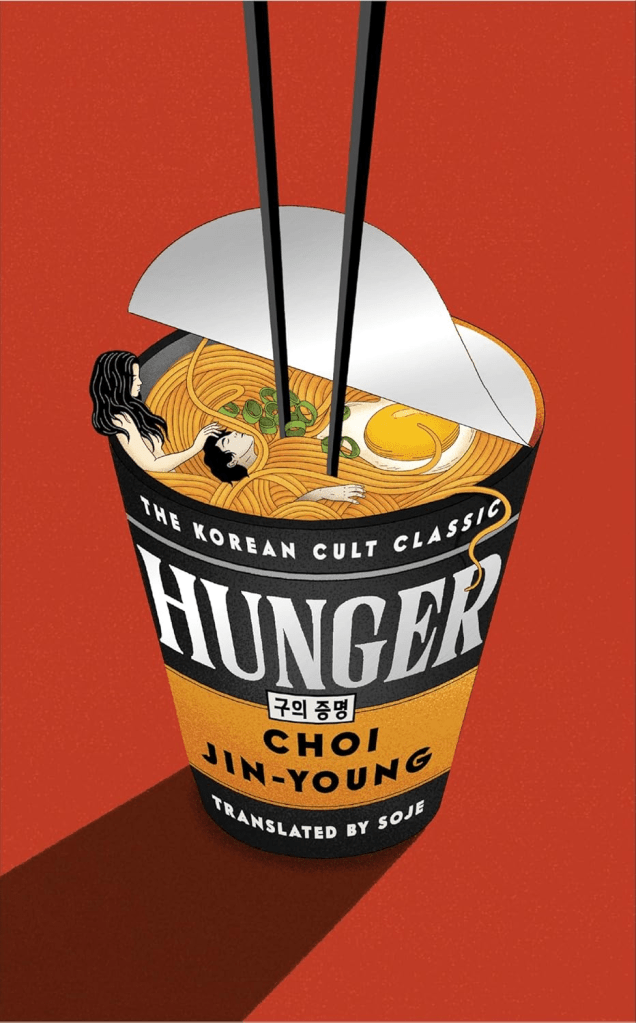
Buy it here:
Synopsis:
A word-of-mouth phenomenon turned best-selling cult classic in Korea, Hunger is a visceral, psychologically daring novel that reveals how love and money shape, wound, and consume us.
“A feast for the literary senses.”—Anton Hur, Judge of the International Booker Prize
On an ordinary afternoon, a woman sees her partner murdered in the street. Time freezes. She lifts his body from the pavement, cradles him home, disinfects each inch of skin—and sits down to begin.
As he witnesses his own funeral from beyond, their two voices—living and dead—lament a lifetime of bone-grinding labor in a society that devours everyone whole. But the woman is no longer willing to bow before law, God, or money. In an act of love and rebellion, she transforms his body into her own, entombing him within her flesh so that he may live again.
Raw, furious, and unflinchingly intimate, Hunger is the Korean underground phenomenon that indicts capitalism, mourns lost love, and pushes the boundaries of what the body can endure for justice and survival. A psychologically and philosophically thrilling novel, it cuts to the core of how we are consumed by the world—and how we might consume it back.
Review:
Hunger by Choi Jin-Young was published in South Korea in 2015. It became a word of mouth hit and a cult classic. The story is the life, love, and fate of Gu and Dam, two people who meet when they are kids, grow connected and in love, and believe they will spend eternity by each other’s side. When Gu is murdered in the street, Dam finds him, brings him home, cleans his body, and decides that the best way to live together forever is to truly become one and make his body part of her body.
The novella is thin and powerful, the narration switches between Gu and Dam, and the entire book can be read in about an hour and a half. But this is not a story you want to rush. Gu and Dam have very deep feelings, thoughts, and desires, not only about their love for each other, but about society and about a world that does not care about regular, everyday people, those who work, want eat a good meal, and focus on a quiet life with the person they love. Instead Gu and Dam learn at an early age that most of life is circumstances out of their control. These moments and people have a tendency to interlope into the simplicity of what life can be by bringing drama and chaos. In the case of Gu and Dam, these moments lead them to make foolish decisions about their relationship, choices that cause even more grief than solutions. These decisions could be placed on their youth, thinking that they are doing what is right while trying to learn how to become adults. It takes them years to realize their youthful decisions are dumb, and they are meant to be together for the rest of their lives.
Gu and Dam are not bad people. Gu’s homicide is not senseless, but he does not get murdered because he is a bad person. He is just a person caught in a bad situation. Bad situations are what dictate their whole lives. Each time they stop seeing each other, it is due an outside catalyst, not a problem between them in their relationship. Their lives are reflective of the problems outside of them, and for most of their lives they do not have the strength as a couple to work through the hard times until it is too late. This also means that by the time Gu and Dam decide they are going to be together no matter what life brings them, they are forced to work within the boundaries of Gu’s troubles. The convictions that they hold through the last of their life together carries on into the afterlife, where even death cannot tear them apart.
The grief and the sadness of Dam and Gu is heartbreaking. Dam is now in the world with her dead partner’s body, and Gu is in the afterlife looking at Dam and thinking about how his love is going to be with her for the rest of her life. The final question is will they love each other again in the next incarnation? Choi Jin-Young has written Hunger like this story is not the first time that Dam and Gu have been in love, that this is not their first incarnation together. When they at five years old, they know immediately, without needing to say anything to each other, that they are going to be partners for the rest of their lives. They prove this, even when they are separated, even when Gu is with another person, even when Dam sits over his dead body, devouring his flesh in a symbol of respect, love, and devotion. This story is not their first story but one of the moments they have in the thousands of years they are together. For as much as this story feels hopeless, the truth is that Hunger is filled with hope.
I received this as an ARC from Europa Editions in exchange for an honest review.


 ghostvillehero