
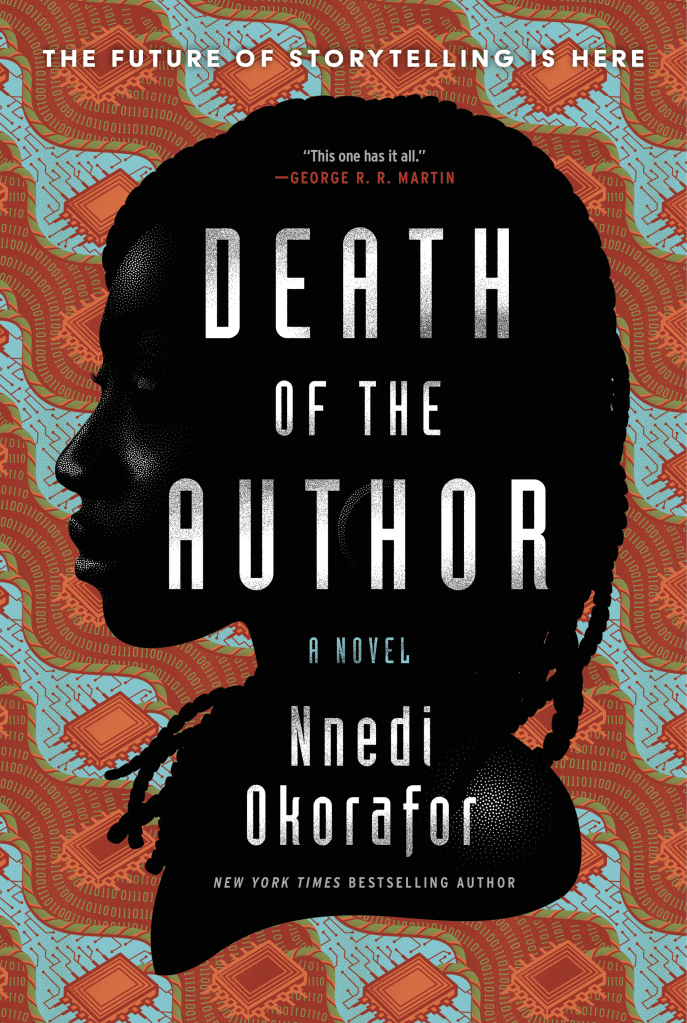
Buy it here:
Synospsis:
The future of storytelling is here.
Life has thrown Zelu some curveballs over the years, but when she’s suddenly dropped from her university job and her latest novel is rejected, all in the middle of her sister’s wedding, her life is upended. Disabled, unemployed and from a nosy, high-achieving, judgmental family, she’s not sure what comes next.
In her hotel room that night, she takes the risk that will define her life – she decides to write a book VERY unlike her others. A science fiction drama about androids and AI after the extinction of humanity. And everything changes.
What follows is a tale of love and loss, fame and infamy, of extraordinary events in one world, and another. And as Zelu’s life evolves, the lines between fiction and reality begin to blur.
Because sometimes a story really does have the power to reshape the world.
Review:
If you are someone who enjoys Nnedi Okorafor’s science fiction and fantasy novels, you will be disappointed in her latest novel Death of the Author, because it has very few sci-fi/fantasy elements. If you are a person who wants a literary novel that involves a Nigerian-American woman in a wheelchair, writing a science fiction novel about robots in a post-human Africa, only to shoot to fame and be torn down just as quickly, Death of the Author is exactly the novel you want to read. The story of Zelu, a Nigerian paraplegic adjunct professor who loses her job, fights with her family, gets too drunk at a wedding, and has an idea for a science fiction novel (a genre she does not even like), unravels as she gathers fame. Her novel is made into a movie, and Zelu gets opportunities that she would not have gotten if she was not a famous artist. Even still, she needs to navigate her family that does not always believe in what she is doing, thinking that she is making mistakes with her choices, and eventually stop contacting her but gets mad when she is not contacting them. Zelu is a strong-willed character, a little angry, a little bitter. All she wants is her own independence, and she feels as if she is underestimated due the fact that she was in a wheelchair most of her life. When she meets a company that helps fit her with prosthetic, robot legs (another decision she receives backlash for from her family and the internet.) While you are rooting for Zelu because it feels as if she is being discredited and underestimated by everyone around her, you also learn they are trying to help her make decisions with her own best interests in mind, choices not made out of spite.
This paradox of Death of the Author is that every choice Zelu makes has a downside, that is pointed out to her. Every event in her life seems to have a disagreement. She gets robot prosthetic legs so that she can walk through life, works very hard to gather the strength and determination to live her life as a person who can walk, and this hard work is called out as someone who is ashamed of her disability, who is trying to be someone she is not. They make a movie version of her novel, Rusted Robots, and they change the setting from Nigeria to America, change the names of the main characters to more American names, and Zelu is angry about it. Her anger is thrown in her face because she does not consider these changes to the story will give something new that the BIPOC population in American can relate to, making Rusted Robot a story for more than one culture, without changing the fact that the novel is based in Nigeria. The fame that she finds makes her angry because it makes her a target, where everything she does and every reaction she has is scrutinized. The overall perceptions of her novel and her success added to her personal actions and her reactions to the pressure she receives from social media, her publisher, her family, and those random fans she sees on the street or in line at the airport puts so much pressure on her that it is only a matter of time before a choice she makes will changes her life once again.
Nnedi Okorafor says in interviews that this is the novel that she has been trying to write for years, that it is the most personal novel she has written. There are enough parallels between her and Zelu that it is easy to assume a great deal of Death of the Author is autobiographical. Zelu is in a wheelchair due to an accident. Okorafor spent her teen years paralyzed after complications of a spinal surgery. Both have large Nigerian-American families, both spent much of their childhood traveling to Nigeria. Both find success writing science-fiction stories set in Nigeria, and both have stress and anxiety that they both have to learn how to control. Okorafor definitely uses Zelu as a reflection of herself and as a way to try to express how she feels about the pressures that have been put on her by her family, her fans, and social media. Some of these pressures have boiled over into Okorafor’s internet life, including a controversy about posting pictures of owls on Threads and when someone asked for spoiler warnings before pictures of owls because they are a dark omen in some cultures, she says, “No.”. She also has had tense words with fans through the years. These incidents could have just as easily been experienced by Zelu and her internet experiences. The pressure on famous people on the internet is relentless, and fandom is something that all successful writers have to live with. Fans also seem to want to break down the wall between fan and artist, and there are moments when fans do forget that their favorite artist is a real human. I am glad that Okorafor has found a way to not only to express her frustrations and her desires but also to give us a way to help us understand our frustrations and desires as well. Death of the Author might not be the novel that we expected from Nnedi Okorafor but is the novel that we need.


 ghostvillehero