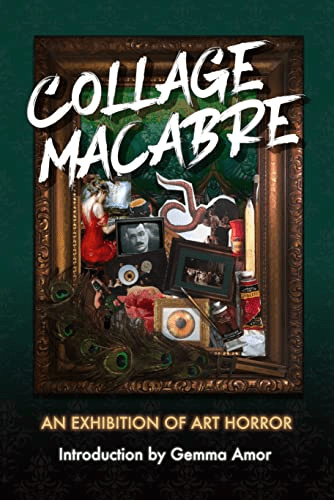
Review: Collage Macabre: An Exhibition of Art Horror

Buy it here:

Amazon

Synopsis:

Your work will betray your secrets. Obsessions, hidden desires, and desperate wishes all woven into the fabric of what we make. A sculpture crafted with longing, a painting of a dream just barely articulated, the craving that cannot speak its name buried in a short film’s score. Old want only spoken aloud through someone else’s voice. Need etched on someone else’s lips for all the world to see. A false self created for the audience to claim as its own, still hiding what it knows.

Through these eighteen stories, dread is the medium of choice, winding its way through each unsettling and terrifying tale about human creation, the artistic follies and triumphs we imbue with so much meaning. You will find artists and audiences alike grappling with confrontations beyond their comprehension, works that require more than careful consideration—sometimes a little bit of blood is necessary. Art is alive if you are. Inside these pages you will be asked to open yourself up like a wound and expose your mind to the darker side of our oeuvre.

Review:

I was given a review copy of Collage Macabre in exchange for an honest review.

Many anthologies have a theme but good anthologies have stories that do interesting things with the theme. The theme for Collage Macabre:An Exhibition of Art Horror is that each story has art as a central part of the plot, and every one of these 18 stories does a good job of stretching that theme as much as possible. We have painters and writers, but we also have stories about graffiti, crocheting, sugar blowing, theater, and moviemaking. None of the authors are household names (except for Gemma Amor who writes the introduction), but this is a collection of authors that will be on your bookshelves in the future. Many of these stories are just that good.

Not only are there huge variations on the theme, but there are so many different types of stories. We are given gothic horror, college horror, horror about grief, obsession, and loss, and of course people who receive strange gifts, people who are haunted, and sacrificial rites. All of these stories are so unique to one another that there is no doubt a reader will enjoy some but not others. This is a normal thing in a good anthology. That means there is something for everyone. 

Another thing about horror anthologies is that it is easy to forget the stories as soon as I read them. Most of the time when I pull up the table of contents after finishing a collection, I have to go back to certain stories to remind me of what it was about. In this case, I am able to recall these stories without doing this, just by the table of contents. There are so many memorable and impactful stories that I can look at the lists of contents and pick out the stories just by the title. A few of my favorites:

 “A Study in Umber” by Jessica Peter. Some rich guys who decide to grind up and drink a lady mummy for inspiration in their artistic endeavors, which of course does not end well for them. 

“Lack” by TJ Price. A girl who’s boyfriend paints a picture that is black, and this blackness unsettles everything in their life. 

“Breath, Blow, Burn” by Ai Jaing. A sugar blower who becomes part of a statue displayed in a home of a family that is falling apart. They watch it all happen, helpless to stop.

“Station 42” by Erik McHatton. A guy who is gifted an old television, that is either a performance piece or a message to drastically change his life.

“Take it from the Top” by Timothy Lanz. A play is being rehearsed, possibly forever.

There are so many other stories that are great, and the writing and editing in every story is strong. Most of these authors do not have many other stories published. This might be off-putting to some readers, but trust me, there are some future stars here. Many of these stories are ready to be adapted into episodes of Creepshow and Blumhouse films. This collection is impressive, and it should be read by anyone who enjoys good horror and/or good short stories. 
Posted in fiction, horror book reviews, Reviews | Tagged , , , , , , , , | Leave a comment

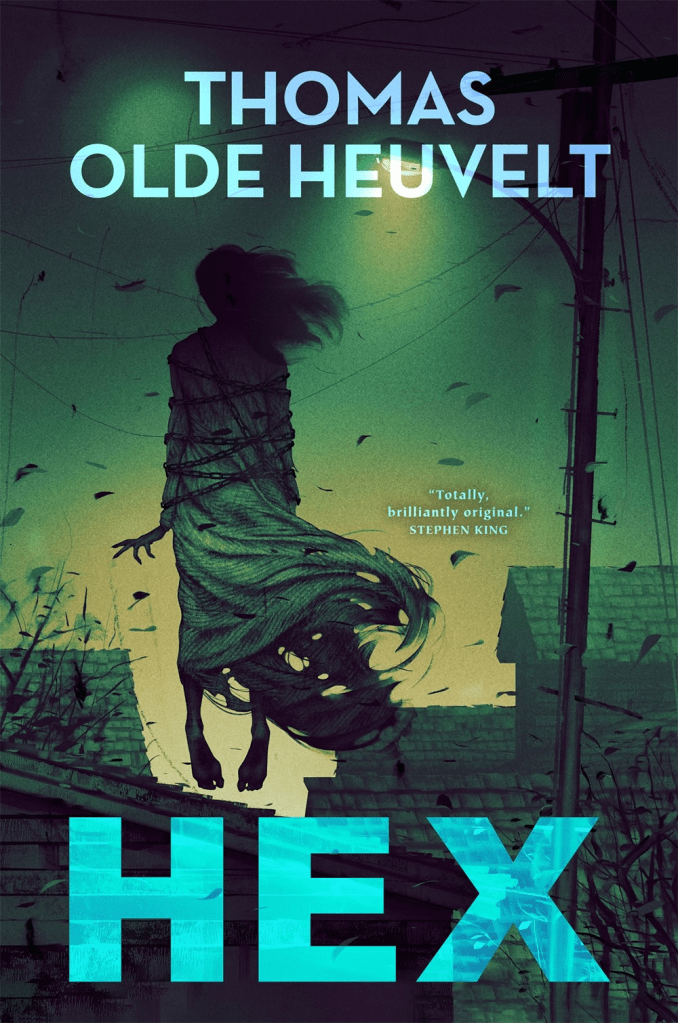
Review: Hex by Thomas Olde Heuvelt

Buy it here:

Amazon, Bookshop

Synopsis:

The English language debut of the bestselling Dutch novel, Hex, from Thomas Olde Heuvelt–a Hugo and World Fantasy award nominated talent to watch

Whoever is born here, is doomed to stay ’til death. Whoever settles, never leaves.

Welcome to Black Spring, the seemingly picturesque Hudson Valley town haunted by the Black Rock Witch, a seventeenth century woman whose eyes and mouth are sewn shut. Muzzled, she walks the streets and enters homes at will. She stands next to children’s bed for nights on end. Everybody knows that her eyes may never be opened or the consequences will be too terrible to bear.

The elders of Black Spring have virtually quarantined the town by using high-tech surveillance to prevent their curse from spreading. Frustrated with being kept in lockdown, the town’s teenagers decide to break their strict regulations and go viral with the haunting. But, in so doing, they send the town spiraling into dark, medieval practices of the distant past.

This chilling novel heralds the arrival of an exciting new voice in mainstream horror and dark fantasy.

Review:

I have had a copy of Hex by Thomas Olde Heuvelt on my Kindle for a long time, but it was not until the Tor Nightfire reissue that I finally picked it to read. I did not know much about it when I first started, and I did not realize I was in for such a treat. 

The novel is about Black Springs, New York, a small town that is haunted by the Black Rock Witch, a woman who was killed by the town in the 1600s. The Black Rock Witch is the town’s dirty secret, a manifestation that they keep track of through a surveillance team, CCTV cameras, and clever ways to hide her during festivals and occasions where out-of-towners are visiting. Unfortunately those who live in town can only leave for short periods of time before they get depressed and suicidal and need to come back home. This has kept the town populated, and the town has worked with the Black Rock Witch for years. Now that there is a group of curious teenage boys and that the internet is largely available, the security is threatened by kids who are technologically smarter than the adults. 

The first part of this novel is fun and surprisingly convincing. We are introduced to the town and the way that the town deals with their curse, and there it is pretty entertaining. The problem is that the kids are going to get the town in trouble with the witch because they keep poking her with experiments and a little bit of bullying. What happens to Black Springs is shocking and well deserved. 

The writing in places is a little odd, and I do not know how much it is Thomas Olde Heuvelt’s original writing and the translation. The original book is set in Beek, a village in south-eastern Netherlands. It is rare for a book translation to change the location for Europe to America, and I do not know how well it is executed. This also makes me question what else has has been changed from the original text. I just know that there are moments when the writing feels a little off. Now that I know that the location has been changed from the original text, I can assume that any other questions that I have might be answered in the original versus the translation.


There were a few moments when I was not engaged in Hex, but most of it really had my attention. This translation was released originally in 2016, so there are a few moments that seem a little dated, but as a whole this stands up as a really great town horror novel. Black Springs has a curse and only a few people bring the entire town into danger. The execution of this is strong and gripping, and I enjoyed every page.

Posted in fiction, horror book reviews, Reviews | Tagged , , , , , , | Leave a comment

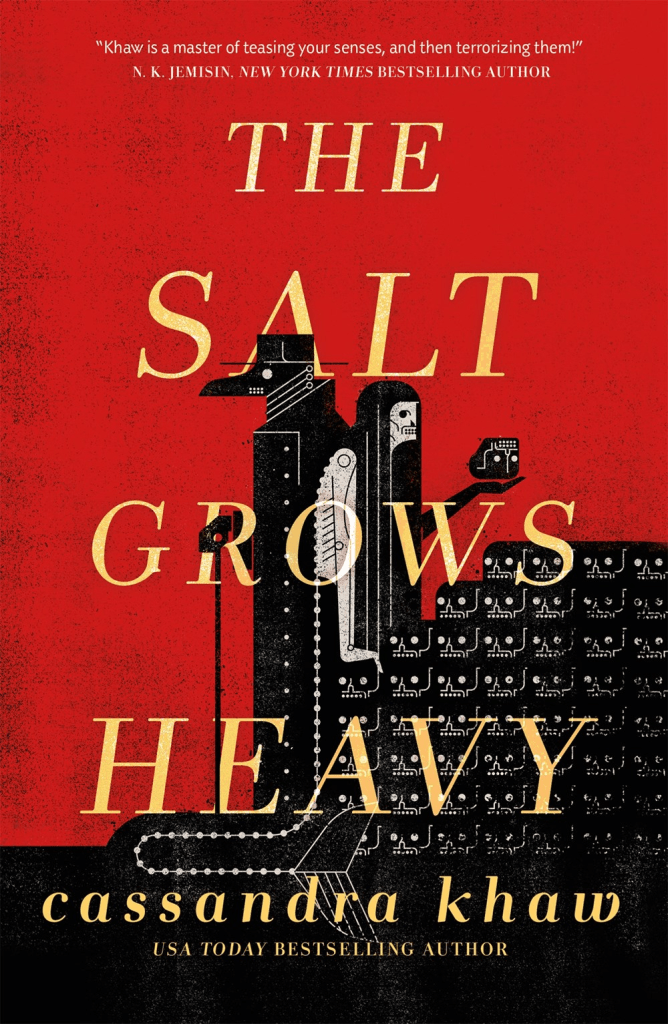
Review: The Salt Grows Heavy by Cassandra Khaw

Buy it here:

Amazon, Bookshop

Synopsis:

From USA Today bestselling author Cassandra Khaw comes The Salt Grows Heavy, a razor-sharp and bewitching fairytale of discovering the darkness in the world, and the darkness within oneself.

You may think you know how the fairytale goes: a mermaid comes to shore and weds the prince. But what the fables forget is that mermaids have teeth. And now, her daughters have devoured the kingdom and burned it to ashes.

On the run, the mermaid is joined by a mysterious plague doctor with a darkness of their own. Deep in the eerie, snow-crusted forest, the pair stumble upon a village of ageless children who thirst for blood, and the three ‘saints’ who control them.

The mermaid and her doctor must embrace the cruelest parts of their true nature if they hope to survive.

Review:

With The Salt Grows Heavy, Cassandra Khaw has written a novella that feels like my worst nightmare. The story starts with the main character, the mermaid who has comes to the sea to marry a prince, sitting in the charred remains of a kingdom that she and her daughters have destroyed. A person dressed as a plague doctor accompanies her out of the desolation and into the world. Make no mistakes. This is not a fairytale even though the main character is a fairytale mermaid. This kingdom is razed. This land is dark. This is a scourge. 

Cassandra Khaw writes deep and beautiful prose. There were times when I could feel everything that the characters felt. I could taste the things that they ate. The pain that they felt seeped from the page and into my own flesh. This denseness is off putting to some. Her sentences are sometimes complex and filled with tough phrasing and unknown words. The likelihood of any reader going through this novella and not having to look up a single word will be rare. However the concentration that the story demands, for us to delve into new language and writing, attaches us to the story, makes us dive deep into a world that is just as new and just as brutal to live through. This is purposeful. For a story that is only a little over 100 pages, this is not a casual read. The reader has to be completely engaged in the story from the very beginning. If we have to work to get into this story, through the writing, the more vivid and horrifying the world becomes. Admittedly, this will turn off quite a few readers, those who are looking for an easy book, but those who stick with The Salt Grows Heavy receive a story that displays great depths in agony and pain. 

This is a very short book, and I love the story and the characters. The mermaid and the plague doctor are compelling and unforgettable. I feel this is a setup book, like The Salt Grows Heavy is just a chapter in their story. This could be the beginning of a series of novellas. If this is a standalone and we never hear from these two characters again, The Salt Grows Heavy is a big treasure in a small package. Even though it takes some effort, the reward is worth it. I hope that it is just the beginning.

I received this ARC from NetGalley in exchange for an honest review. 

Posted in fiction, horror book reviews, Reviews | Tagged , , , , , , , , , , | Leave a comment

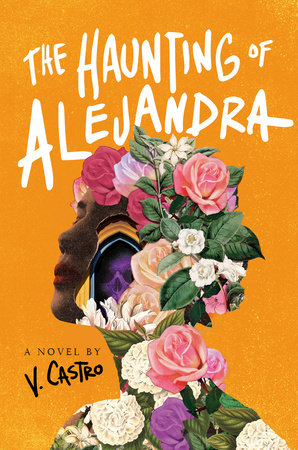
Review: The Haunting of Alejandra by V. Castro

Buy it here:

Amazon, Bookshop

Synopsis:

A woman is haunted by the Mexican folk demon La Llorona as she unravels the dark secrets of her family history in this ravishing and provocative horror novel.

Alejandra no longer knows who she is. To her husband, she is a wife, and to her children, a mother. To her own adoptive mother, she is a daughter. But they cannot see who Alejandra has become: a woman struggling with a darkness that threatens to consume her.

Nor can they see what Alejandra sees. In times of despair, a ghostly vision appears to her, the apparition of a crying woman in a ragged white gown.

When Alejandra visits a therapist, she begins exploring her family’s history, starting with the biological mother she never knew. As she goes deeper into the lives of the women in her family, she learns that heartbreak and tragedy are not the only things she has in common with her ancestors.

Because the crying woman was with them, too. She is La Llorona, the vengeful and murderous mother of Mexican legend. And she will not leave until Alejandra follows her mother, her grandmother, and all the women who came before her into the darkness.

But Alejandra has inherited more than just pain. She has inherited the strength and the courage of her foremothers—and she will have to summon everything they have given her to banish La Llorona forever.

Review:

Alejandra, the main character in V. Castro’s newest novel The Haunting of Alejandra, is dissatisfied with her life. With three kids and a husband who makes enough money and has the mindset that she can be a stay-at-home mother, she feels like her life is a prison. Her husband is gone for work for long periods of time, and she is in a small box that is closing in on her and make her wish that she was anyone else. When she starts to be haunted by a woman dripping with water and wearing a white dress that looks like a patchwork of rotting flesh, she starts to search for the answers, not only for why this woman is haunting her but also the answers about her heritage, her family, and who she really is.

This is my fourth V. Castro book, and there is a pattern to her stories that is emerging. Castro writes strong female characters who either have fierce independence or are looking for it. Whether it be Leticia Vasquez in Aliens: Vasquez, Belinda Alverez in Queen of the Cicadas, or Alejandra in this novel, Castro’s main characters are either women you do not want to cross or women growing into their roles as strong, fierce, and proud women. With Castro’s work, you also receive the spirits of ancestors, women who came before them to pave the way for their success. In the case of Alejandra, these women manifest as the females in her entire ancestral line, a line that she does not know at the beginning of the story but relies on by the end.

Castro also uses Mexican history and folklore to tell her stories. This weaving of old traditions with new fiction makes her work stand out. Not only does she write a good plot, but she places enough history throughout to where the reader feels like they understand Latinx culture just a little more. Castro has so many important groups of people that she represents. With her crosshatching of stories that represent Latinx culture, strong female protagonists, and great horror, V. Castro has solidly placed her in the middle of a list of who’s who in strong voices in this new golden age of horror. 

I received this as an ARC from NetGalley in exchange for an honest review.

Posted in fiction, horror book reviews, Reviews | Tagged , , , , , , , , | Leave a comment

Review: Human Acts by Han Kang

Buy it here:

Amazon, Bookshop

Synopsis:

From the internationally bestselling author of The Vegetarian, a rare and astonishing (The Observer) portrait of political unrest and the universal struggle for justice.

In the midst of a violent student uprising in South Korea, a young boy named Dong-ho is shockingly killed.

The story of this tragic episode unfolds in a sequence of interconnected chapters as the victims and the bereaved encounter suppression, denial, and the echoing agony of the massacre. From Dong-ho’s best friend who meets his own fateful end; to an editor struggling against censorship; to a prisoner and a factory worker, each suffering from traumatic memories; and to Dong-ho’s own grief-stricken mother; and through their collective heartbreak and acts of hope is the tale of a brutalized people in search of a voice.

An award-winning, controversial bestseller, Human Acts is a timeless, pointillist portrait of an historic event with reverberations still being felt today, by turns tracing the harsh reality of oppression and the resounding, extraordinary poetry of humanity.

Review:

Han Kang made a big splash in the United States with a translation of her novel The Vegetarian. The novel was labeled disturbing and weird, but there was also some controversy about the liberties taken by the translator. When I finished it, I felt a little underwhelmed by the whole experience. I liked it okay but I did not think it was nearly as great as what everyone was saying. It took me about a year to pick up another novel by her, her second released in translation called Human Acts. I wish I would have read this as my first Han Kang novel. 

The story is about Dong-ho and the student uprising that turned bloody and violent when the military stormed the city and shot their guns into the crowds of protesters. Dong-ho is just a kid in 1980 looking for his missing friend in the middle of all of this. He volunteers at a gymnasium where they line up the bodies of the dead for family members to identify. He wants to help, but he also wants to be there if the bodies of his his friend or his sister come in. After the first chapter, the book chronologically moves from 1980 to 2012, with each chapter exploring the memories of people around Dong-ho during this time 0and the student uprising that left its mark on the city of Gwangju. As time passes in the novel, the story gets further and further but the memories of the boys, the uprising, and the massacre by the military never disappear. 

This book is incredible. The first chapter does make it a rough start because Han Kang has written it in second person, with the “you” being Dong-ho’s lost friend. There has not been a novel where this was not a poor choice. It is important that the reader does not skip the first chapter because it does set up the rest of the book, but after the beginning of the second chapter, you will forget this initial awkwardness. Han Kang’s writing is clear and concise and will rip out your guts. There is not a single sentence or scene that feels like a waste of time. We get lost in the feelings of these characters and how they deal with their losses from Gwangju and the student uprising. Each part has an entirely different narrator, with a different perspective, but the one common denominator of all of these people, one common memory threaded throughout the book is the memories of Dong-ho looking for his friend.

Even though The Vegetarian was not my favorite novel, Han Kang redeems herself with Human Acts. She has a new novel coming out in a couple weeks called Greek Lessons, which is a translation of her novel from 2011. I will be looking forward to reading this next because Human Acts really made me a fan of her work.

Posted in Uncategorized | Tagged , , , , , , , , , , | Leave a comment

Review: 88 Names by Matt Ruff

Buy it here:

Amazon, Bookshop

Synopsis:

John Chu is a “sherpa”, a paid guide to online role-playing games like the popular Call to Wizardry. For a fee, he and his crew will provide you with a top-flight character equipped with the best weapons and armor, and take you dragon-slaying in the Realms of Asgarth, hunting rogue starships in the Alpha Sector, or battling hordes of undead in the zombie apocalypse.

Chu’s new client, the pseudonymous Mr. Jones, claims to be a “wealthy, famous person” with powerful enemies, and he’s offering a ridiculous amount of money for a comprehensive tour of the world of virtual-reality gaming. For Chu, this is a dream assignment, but as the tour gets underway, he begins to suspect that Mr. Jones is really North Korean dictator Kim Jong-un, whose interest in VR gaming has more to do with power than entertainment. As if that weren’t enough to deal with, Chu also has to worry about “Ms. Pang,” who may or may not be an agent of the People’s Republic of China, and his angry ex-girlfriend, Darla Jean Covington, who isn’t the type to let an international intrigue get in the way of her own plans for revenge.

What begins as a whirlwind online adventure soon spills over into the real world. Now Chu must use every trick and resource at his disposal to stay one step ahead—because in real life, there is no reset button.

Review:

Between the very popular novel Lovecraft Country and the sequel, Destroyer of Worlds, Matt Ruff published a novel about video games. 88 Names follows John Chu, a “sherpa” who has a group of gamers that help players complete challenges for a price. In open world online video games, this is something that people with a great deal of money but no time hire to have a fun time in the video games without doing the hours of character building and rough work. John makes money by helping them with the video game experience, and this is also how he gets his accounts banned. Fortunately he has several accounts, several characters that he can draw from at any moment. When he gets a job from a mysterious player named Mr. Jones, he finds himself deeper into a thriller than he expected when he started playing a game. 

88 Names is readable and somewhat interesting, but as a whole, the plot seems pretty bland. The only thing that keeps this somewhat interesting is the variations on the games that John Chu plays online. We do not get a ton of repetition of John playing the same game over and over. In fact we barely get the same thing twice. Instead we get a bunch of different games, including a Star Wars like war game, a Grand Theft Auto like heist game, and even a text based circus/carnival game. The games are varied enough to where I kept reading the book, but in the end, the overarching plot falls kind of flat. The one thing that did get me through the novel was that I thought it was pretty funny. There is times when the trolling between characters is amusing, but maybe this is something that those who do not play games online do not experience. I can see some readers having zero connection to this world or the characters, thus making for a miserable reading experience.


I did like Lovecraft Country, and I am excited to read Destroyer of World, but this novel does not do much for me. It really does not feel up to the same standards as much of the rest of Matt Ruff’s collected work. Even though the idea of a VR, video game novel seems like a fun time, 88 Names is not as fun as it promises to be.

Posted in fiction, Reviews | Tagged , , , , , , , , , | Leave a comment

Review: Chasing the Boogeyman by Richard Chizmar

Buy it here:

Amazon, Bookshop

Synopsis:

The New York Times bestselling coauthor of Gwendy’s Button Box brings his signature prose to this story of small-town evil that combines the storytelling of Stephen King with the true-crime suspense of Michelle McNamara.

In the summer of 1988, the mutilated bodies of several missing girls begin to turn up in a small Maryland town. The grisly evidence leads police to the terrifying assumption that a serial killer is on the loose in the quiet suburb. But soon a rumor begins to spread that the evil stalking local teens is not entirely human. Law enforcement, as well as members of the FBI are certain that the killer is a living, breathing madman—and he’s playing games with them. For a once peaceful community trapped in the depths of paranoia and suspicion, it feels like a nightmare that will never end.

Recent college graduate Richard Chizmar returns to his hometown just as a curfew is enacted and a neighborhood watch is formed. In the midst of preparing for his wedding and embarking on a writing career, he soon finds himself thrust into the real-life horror story. Inspired by the terrifying events, Richard writes a personal account of the serial killer’s reign of terror, unaware that these events will continue to haunt him for years to come.

A clever, terrifying, and heartrending work of metafiction, Chasing the Boogeyman is the ultimate marriage between horror fiction and true crime. Chizmar’s writing is on full display in this truly unique novel that will haunt you long after you turn the final page.

Review:

Chasing the Boogeyman by Richard Chizmar has an excellent premise. This book is billed as a fictional account of a serial killer but is supposed to present like a true crime book. There are even photograph inserts like true crime books, photographs of victims, crime scenes, and major players to the plot. The setup seems like this could be one of those fantastic books that changes everything. But it’s not. 

I read the first 100 pages of this novel when it first came out in August 2021. Then I put it down. For almost two years. I borrowed an audiobook version of it from my local library, and this was really the only way that I could get through it, by being stuck in a car for hours, driving and listening.

The initial idea is so promising, but instead of writing a book that resembles a true crime nonfiction book, Chizmar writes a novel that reads like Stephen King Lite.

 Stephen King writes horror novels with an undercurrent of nostalgia. His down home, “aww shucks” attitude peppers all of his stories. King can pull it off because he is good at it, but also because  he is so prolific with such a fan base, that those fans who do not really care for his deep moments of nostalgia still read and write glowing reviews of his novels. King’s plots can outshine the writing. Chizmar tries to do the same thing, but his moments of nostalgic passages fall a little flat. His main character, a younger version of himself named Richard Chizmar, comes home from college to start his magazine, Cemetery Dance. The crime spree just happens to take place between him buying hot dogs and Slurpees and eavesdropping on the old timers talking at the local 7-Eleven, writing short stories in his room, getting these stories rejected, and reading the newspaper every day with his parents. Chizmar, as a main character, is a pretty boring guy, and this makes the parts that are loosely based on his life boring as well.


This is a great concept, but I did not care much for the execution. Most of it is because the chapters about Chizmar and the things that he is doing after college really distracts from the reason why we were drawn to this book in the first place, trying to catch a killer. Maybe my expectations were wrong. I was hoping for a novel that read like a true crime book, objective and a step or two removed from the action, maybe even returning to town to investigate these cold cases instead of tampering with an active investigation. Chasing the Boogeyman is a novel that reads like a novel, and most of the parts that focus on the life of the main character keep this from being a great book.

Posted in horror book reviews, Reviews, Uncategorized | Tagged , , , , , , , , | Leave a comment

Review: Lone Women by Victor LaValle

Buy it here:

Amazon, Bookshop

Synopsis:

Blue skies, empty land—and enough room to hide away a horrifying secret. Or is there? Discover a haunting new vision of the American West from the award-winning author of The Changeling.

Adelaide Henry carries an enormous steamer trunk with her wherever she goes. It’s locked at all times. Because when the trunk is opened, people around her start to disappear…

The year is 1914, and Adelaide is in trouble. Her secret sin killed her parents, and forced her to flee her hometown of Redondo, California, in a hellfire rush, ready to make her way to Montana as a homesteader. Dragging the trunk with her at every stop, she will be one of the “lone women” taking advantage of the government’s offer of free land for those who can cultivate it—except that Adelaide isn’t alone. And the secret she’s tried so desperately to lock away might be the only thing keeping her alive.

Told in Victor LaValle’s signature style, blending historical fiction, shimmering prose, and inventive horror, Lone Women is the gripping story of a woman desperate to bury her past—and a portrait of early twentieth-century America like you’ve never seen.

Review:

I love Victor LaValle and I look forward to everything that he writes. It is no surprise how excited I was to learn that the following up novel to The Changeling was going to be a historical horror novel set in the American west. I know that westerns and horror have been popular lately (see Death Head’s Press’s Splatter Western series), so I was really excited to see what LaValle would bring to the table.

I thought of the movie Airheads when the title was revealed, the 90s comedy starring Brendan Fraser and Adam Sandler. Their band was called the Lone Rangers, and someone made the comment of how can they be “lone” if there are three of them? I started this book with this same question in my head. How could they be “lone” if the title refers to “women”? It is discovered that “lone women” refers to homesteaders in Montana, particularly single or widowed female homesteaders who traveled to Montana to cultivate the land. Adelaide Henry shows up from California to stake her claim, carrying nothing but a steamer trunk that is almost too heavy to move. There are secrets inside the trunk. secrets that Adelaide and her family have spent her lifetime trying to hide. Now that she is out in a land of endless isolation and wind, the only thing that she can do is face her past and her secrets.

LaValle might be talking about “lone women” being those single homesteaders who are working the land to make a life of their own, but the “lone women” element also refers to the differences between Adelaide as an African-American homesteader and the way the white women in the nearest town of Big Sandy treat her and the other few minority women. The Reeds own the opera house and the entire town. Jerrine Reed leads the Busy Bees social club, and one of their commitments is promoting female ran businesses. One of the businesses is a new laundry service by Mrs. Metta Sterling and her son. The thing about this is the town already had a female ran laundry service, but the person in charge of that, Fiona Wong, happens to be Chinese. There is a fissure between the white women and the minority women in town. The minorities become their own faction, not only because they are are pushed away from the other women in town, but also because they do not seem swayed by the influence of the Reeds. These outcasts turn into “lone women” and band together to form their own close knit group. 


Lone Women does have enough different elements in it that keeps the story moving and interesting. This story is a fresh mix of not only horror but of mystery, adventure, and politics, but the freshness is heavily steeped in so many elements that are classic to horror. I love all of LaValle’s novels. This is not my favorite one, but it is enjoyable and a very solid western horror.

I received this as an ARC from NetGalley and the publisher in exchange for an honest review.

Posted in horror book reviews, Reviews, Uncategorized | Tagged , , , , , , , , , | Leave a comment

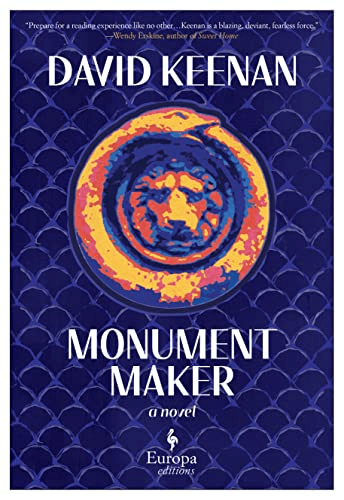
Review: Monument Maker by David Keenan

Order it here:

Amazon, Bookshop

Synopsis:

David Keenan is one of today’s most exciting, fearless, and entertaining writers. Monument Maker is his most daring book to date.

Is it possible for books to dream? For books to dream within books? Is there a literary subterranea that would facilitate ingress and exit points through these dreams? 

These are some of the questions posed by David Keenan’s Monument Maker, an epic romance set in an eternal summer, and a descent into history and the errors of the past; a novel with a sweep and range that runs from the siege of Khartoum and the conquest of Africa in the 19th century through the Second World War and up to the present day, where the memories of one summer and an unforgettable love affair unravel. 

A book within a book within a book, a meditation on art and religion, and on what it means to make monuments. A hallucinatory epic and a forward-looking history of the world, Monument Maker was written over the course of ten years and represents the apex of Keenan’s project to create books that are themselves teeming with organic life. 

“I sometimes think David Keenan dreams aloud. His prose has the effortless enigmatic, unsettling quality of dream.”—Edna O’Brien

Review:

I received Monument Maker as an ARC from Europa Editions in exchange for an honest review.

When I reviewed David Keenan’s last Europa Edition release, Xstabeth, I thought it was an interesting way to tell a story. The author is a dead person who is writing about a girl who might be dead or alive and this confusion is compelling, complete with asides about science and language that only make sense metaphorically. After spending many hours reading Monument Maker, David Keenan has swept me into an even bigger story, one that not only shares the same universe as Xstabeth, but one that is much bigger than even the story on the pages told here. A story that is as endless and timeless as art, science, and the galaxy.

The basics of the story is the telling of Pierre Melville’s life, an artist who lives with Maximilian Rehberg and writes science fiction novels under the pen name Paimon. But this is not right. The real basics of the story is a third of their party, Frater Jim, who is a time traveler and tells the story in a World War II camp about how he got a face transplant, in the future, from Nazis wearing monkey suits, but returned back to the camp to tell how he got this procedure done. Frater Jim is a Janusist, one who lives forward and backward at the same time. But this is not right either. The real basics of the story is the exploration of art and the way that it changes and moves throughout the years and how all art is like religion, where every piece of art, every stone, every writing, painting, song should be studied and worshiped and those who make it should be seen as gods. Every piece of art needs a monument made for it, and David Keenan is the monument maker.  

Monument Maker is a mosaic with hundreds of little pieces that can be put together in any order because the picture will be up for the reader’s interpretation anyway. One of the smallest of passages close to the end of the novel brings this to light:

“Suddenly I was struck by a terrifying thought. Was it possible for books to dream? Could it be that every time a book was closed it fell into a deep slumber wherein it dreamed itself as something else? I considered myself an erudite man, well read, able to discourse at length on the classics. Could it be that I was simply a victim of fancy and fate? That all I had remembered and studied and was able to quote at length, all that I had in fact lived by, was nothing but the night-time reveries of books dreaming themselves? In that case the history of literature was nothing but a phantom; no one had ever read the same book.” (pgs. 619-620)

This feels like an thesis of the entire novel. Books are a fluid thing and even when we close the pages, when we open them again, the novel has dreamed and has changed. It is not the novel itself, the words have turned into something else, but us, as the readers have changed, even if is just slightly. Within a few minutes of taking a break, we are not the same person that closed the book earlier. We might have forgotten a small detail. We might have made up the true synopsis of what we think Monument Maker may be about but changed it while taking a shower or cutting the grass, only to return to reading with filtering the story now through a different lens. Books are constantly changing because the reader is constantly changing. We change our feelings and interpretation all of the time, and the idea that “no one has ever read the same book” is one hundred percent accurate. 

There are so many things I have been thinking about since finishing Monument Maker, and one of them is how important art and artists are to David Keenan and his writings. In both of the novels I have read by him, he has focused on an obscure artist and the people who surround these artists and worship them, turning their following into a small cult. This group, sometimes 20 or 30 people worldwide, are devoted to these artists, even when these said artists really have not released a massive amount of work, sometimes just one obscure book. In Keenans’ world, if someone writes a slim novella or someone paints a few canvases, there is a potential that a group of people will follow this artist, try to learn everything about them, and will obsess over every move that the artist makes. This devotion to the artist, regardless of obscurity, seems to be one of those things that Keenan likes to fantasize about, like how every single little piece of art has the potential to make someone a devout to the artist and his life. This exhibits a sincerity to the value of art in David Keenan’s life, otherwise this phenomenon would not continue to be a major plot in his novels. 


As a whole, Monument Maker is a huge and difficult book. I say this in the most loving way possible. I enjoy it because I enjoy the way David Keenan writes, but it is not for everyone. His novel is nonlinear, metaphorical, and really has made me think a great deal about the meaning behind his choices. Some of the sentences are pages long, some of the little details turn into pages of falling down a rabbit hole of information (like the idea that Goya should paint what might possibly be on the flag that is planted on the moon if we were to land in a joint world effort and why). There is not really an imbalance in this book because there is never really much balance. Book Four is far removed from Book One, and the appendixes are just as important to the novel as the four parts, including the science fiction story by Paimon. In the end, it is one of those books that I enjoyed the journey and the difficulty, like I really feel like I accomplished something serious by finishing it and mulling over the multiple meanings. If you are hesitant to read Monument Maker check out Xstabeth first, to get a taste for the way that David Keenan constructs his universe. But who knows, maybe you should just start with Monument Maker. Maybe the book that you read will be completely different than the one that I read. That is how books dream, right? 

Posted in fiction, literary book review, Reviews, Uncategorized | Tagged , , , , , , | Leave a comment

Review: #thighgap by Chandler Morrison

Buy it here:

Amazon, Bookshop

Synopsis:

Don’t read with the lights on…this is My Dark Library.

A collection of novellas curated by Sadie “Mother Horror” Hartmann to represent her favorite themes, tropes, and subgenres in horror fiction today.

BOOK TWO: #thighgap by Chandler Morrison –

Los Angeles fashion model Helen Troy wasn’t always skinny. Drastic weight loss has given her everything–money, confidence, attention, respect. Being thin has legitimized her, and starvation has become an addiction.

Following an encounter with a seemingly “perfect” rival model who destabilizes Helen’s shaky self-confidence and shatters her fragile illusion of control, she’s sent into a tragic tailspin that will take her to the lowest depths of hell. Nightmarish versions of herself begin materializing in mirrors, and her tried-and-true coping mechanisms stop working. Reality comes apart at the seams as Helen’s disease manifests in increasingly self-destructive fashions, forcing her to ask herself…

What does perfection look like, and how much would you sacrifice to obtain it?

Review:

Chandler Morrison’s novella, #thighgap is about a young woman, Helen Troy (her stage name), who moves to Los Angeles and becomes a semi-famous model after she loses a bunch of weight through starvation and drug use. This book covers some severe body dysmorphia and eating disorders, so if this is a subject that you struggle with, you might want to skip this one. 

#thighgap has characters with serious problems. Morrison has built a world where nobody is really engaged with anything besides themselves. One of Morrison’s previous books is titled Dead Inside, and that could be the name of this novella as well. All of these characters are dead inside and not even interested in connecting to anyone in a meaningful way. Many scenes have sentences about people wearing sunglasses. Even sex scenes where people are still wearing their sunglasses. This is really to hide the total numbness that every single person in this world feels and displays. The only thing that most of the characters in this novella care about is how they look, where the next party is, where to get more drugs, and how skinny they are compared to everyone else in the room. This superficial wasteland that Helen and her circle of acquaintances (I can’t say friends because no body is a friend here) live in makes the maintenance of being part of the group a struggle. This causes more and more drastic measures. In the few moments that Helen does reach out to get help for her disorders, she is met with people who really do not care. The most irritating of these people is her actual therapist, who basically tells her that she is doing good and wants her to go to his comedy show, talking to her the whole time from behind sunglasses while scrolling Instagram. 


I know that body dysmorphia and body acceptance are serious subjects. Many people are trying to change the culture by advocating for more body acceptance, and I know that our society has gotten a little better, but really we are doing the bare minimum. When it comes to modeling and acting, there is still less acceptance of those who looks like normal people versus a person who is very skinny. Chandler Morrison chooses #thighgap to highlight this problem, but there is no real proposed solution. This novella and these characters ring true because we treat people like Helen Troy like celebrities. Until we stop hiding our dead eyes behind sunglasses and start to really examine our culture and it’s priorities, nothing much will change. We will continue to be like the people who tip one dollar to waitresses simply because they are told to tip. The true culture will not change. #thighgap highlights these truths in a story that might be hard for some people to read. 

Posted in fiction, horror book reviews, Reviews | Tagged , , , , , , , , , , | Leave a comment