Review: Below by Laurel Hightower

Pre-order Here: Ghoulish Books

Synopsis:

While driving through the mountains of West Virginia during a late-night snowstorm, a recently divorced woman experiences bizarre electrical problems, leaving her with little choice but to place her trust with a charismatic truck driver. But when an unexplainable creature with haunting red eyes gets between them, she is forced to make one of the toughest decisions of her life. Will she abandon the stranger who kept her safe—or will she climb down below, where reality has shapeshifted into a living nightmare?

Review:

Laurel Hightower’s last novella, Crossroads, created a huge stir in the horror community. It follows the story of Chris and her grief over her dead son. Almost everyone who read it loved that Hightower is able to make us feel so much in such a short novella. Her follow up, Below, is coming with some big reader expectations, and Hightower definitely proves that she is up to the challenge.

Below starts with Addy on her way to meet some friends for a girls weekend after a fresh divorce to Brian. There is an impending snowstorm coming, and after she nearly hits a disabled van in the middle of the road, she pulls off to a truck stop to gather her thoughts. She meets a tucker named Mabs, who wants to help her through the mountains and the storm. The journey after they leave the truck stop does not go well. In the end, Addy has to confront her own demons as well as those that are trying to kill her.

There are so many things that Laurel Hightower does well in her writing. She excels at storytelling, but the development of her main characters is unprecedented. Addy is someone who has an inner dialogue that leads her to second guessing her every move. The three main characters in this novella are Addy, Mags, and Brian, her ex-husband who’s voice is constantly in her head as she makes decisions that he would not have approved of. She has been so beaten down by this relationship and this person, yet it is still so raw to her emotions, that when her state of fear heightens, she has to choose whether to continue to listen to those ghost in her head telling her who she is and what she should do or whether to break herself from these chains. 

Hightower does such a great job creating Addy and her life, but this does not distract from the fact that this a novella of pure terror. As soon as she leaves the truck stop and continues on her journey, there is not a single moment that is not filled with tension, whether it be due to the weather conditions, what lives in the mountains, or what lives in the caves below. She spends much more of this novella on the action and horror than she did in Crossroads, which was more of a psychological horror about grief and loss. Below is awesome because even though it is more of a creature feature, the character development does not stop. Addy is still learning, still getting stronger as the worlds is turning into a nightmare around her. Laurel Hightower can write good creatures too. 

There is not a single reason why any horror lover should pass on Below or any other Laurel Hightower book. The level of horror that she produces is one that should make other horror writers think they need to work harder and write better.

I received this as an ARC from the publisher in exchange for an honest review. 

Posted in fiction, Reviews | Tagged , , , , , , , , , , | Leave a comment

Review: Night Shift by Stephen King

Buy here: Amazon, Bookshop

1278424

Synopsis:

Never trust your heart to the New York Times bestselling master of suspense, Stephen King. Especially with an anthology that features the classic stories “Children of the Corn,” “The Lawnmower Man,” “Graveyard Shift,” “The Mangler,” and “Sometimes They Come Back”-which were all made into hit horror films.

From the depths of darkness, where hideous rats defend their empire, to dizzying heights, where a beautiful girl hangs by a hair above a hellish fate, this chilling collection of twenty short stories will plunge readers into the subterranean labyrinth of the most spine-tingling, eerie imagination of our time.

Review:

I have been reading Stephen King books since I was in junior high. At that age, his books are huge and daunting. It, The Stand, and The Tommyknockers are such long books that I had trouble starting them, let along getting through them. But I wanted to read Stephen King, so I decided to try his short stories. Night Shift was not the first King book I tried to read, but it was the first King book I finished. 

Now I am reading these stories again, and so many of them have been made into movies and pieces of anthology series, it is remarkable how much of the material has been mined for content. Even as recently as the new Creepshow series on Shudder has made “Gray Matter” into an episode. Some of these stories are just as good as I remembered them being when I was twelve or thirteen reading them, but like a lot of King, some of the language and characters have not age well. I read through these stories, and some of the lesser known stories, like “Night Surf” and “Strawberry Spring,” feel like first stories in a young career, where King’s story telling abilities were still in development. These are overshadowed by some really great stories, and Night Shift is really one of the quintessential, top five must read King books. 

There are only a few stories I remember vividly from reading this collection thirty years ago. Two of them, “The Mangler” and “Graveyard Shift” really stuck with me through the years. (I might have seen the film adaptations of these two stories. I know they exist, and I am sure I wanted to see them). “The Mangler” is about a possessed industrial folding press that kills those who work on it, and “Graveyard Shift” is about rats of unusual size. Both of these are about work and elements that change jobs to make them dangerous. I just remember these two much more than many of the others. Of course I do know some of the other stories because of their movie adaptations. “Sometimes They Come Back” and “Children of the Corn” are ones that I remember as movies more than stories, and “Children of the Corn” is very different from the movie adaptation. The movie is more in the classic consciousness of horror fans than the story (which only mentions Isaac and does not have him as any sort of important character). I will be honest. There are some of these stories that are even better now, thirty years later, than they were when I first read them. “Gray Matter”, “Sometimes They Come Back”, and “One for the Road” are so much better than I ever remember them being. “One for the Road” might be my favorite story in this collection. Something about snowstorms and vampires really go well together.

I have been meaning to revisit this collection for years, and I am glad I finally did. One difference between reading them as a young man and reading them now is that now they are not nearly as hard to read. I remember spending hours reading this book and taking a long time to comprehend what was happening. I fondly remember spending a long time in my room just reading, getting into the stories and being scared. I think the nostalgia of this collection sways me a little bit, but it is still one of King’s best books. Not only is it one of his best books, it is one of the best collections of horror short stories I know. I recommend this to the young reader, who is wanting to get into Stephen King’s books and to any reader of horror fiction.

Posted in Reviews | Tagged , , , , , , , , | Leave a comment

Review: The Strange Bird: A Borne Story by Jeff VanderMeer

The Strange Bird: A Borne Story

Buy it Here: Amazon, Bookshop

Synopsis:

The Strange Bird—from New York Times bestselling novelist Jeff VanderMeer—is a digital original that expands and weaves deeply into the world of his “thorough marvel”* of a novel, Borne.

The Strange Bird is a new kind of creature, built in a laboratory—she is part bird, part human, part many other things. But now the lab in which she was created is under siege and the scientists have turned on their animal creations. Flying through tunnels, dodging bullets, and changing her colors and patterning to avoid capture, the Strange Bird manages to escape.

But she cannot just soar in peace above the earth. The sky itself is full of wildlife that rejects her as one of their own, and also full of technology—satellites and drones and other detritus of the human civilization below that has all but destroyed itself. And the farther she flies, the deeper she finds herself in the orbit of the Company, a collapsed biotech firm that has populated the world with experiments both failed and successful that have outlived the corporation itself: a pack of networked foxes, a giant predatory bear. But of the many creatures she encounters with whom she bears some kind of kinship, it is the humans—all of them now simply scrambling to survive—who are the most insidious, who still see her as simply something to possess, to capture, to trade, to exploit. Never to understand, never to welcome home.

With The Strange Bird, Jeff VanderMeer has done more than add another layer, a new chapter, to his celebrated novel Borne. He has created a whole new perspective on the world inhabited by Rachel and Wick, the Magician, Mord, and Borne—a view from above, of course, but also a view from deep inside the mind of a new kind of creature who will fight and suffer and live for the tenuous future of this world.

Review:

The Strange Bird is another chapter in the Borne novel, and reading Borne first is strongly recommended.

I have been thinking about The Strange Bird and the journey that she makes through this novella. The Strange Bird is made in a laboratory, and she is a bird mixed with several other strands of DNA, including human DNA. This gives her a consciousness and a voice. She escapes, gets attacked, gets captured, escapes almost, escapes again, gets caught, gets disassembled, gets torn apart, gets reassembled, and escapes one last time. This seems like it is quite an adventure for the Strange Bird in a short period of time, but the most interesting thing about this novella and VanderMeer’s writing this time around is that there is so much expansion in such a small space. The universe and life seems infinite. The story is much more vast than the actions of the strange bird, much more time is spent feeling the sense of sadness and dread that all of the characters have for the world that no longer exists in the way that anything can flourish besides nature, animals, and time. The humans know that they are dying out, and the only real things that are thriving in this ruined city are the biotech animals.

There are watchful eyes in every aspect of this story, a sense of curiosity from the blue fox that follow the Strange Bird through the city, but also a sense of possession from the humans. The people who try to possess the Strange Bird are so used to loss that they want to hold onto something, anything, for a period of time. This turns the idea of the Strange Bird into a story about a prisoner, someone who is trying to escape those who are trying to imprison her. We can see that those who want to possess the Strange Bird do not always have the best intentions, and so we feel like hope is the only thing that she has to hold onto, making her on equal to everyone else living in this world.

It is a dynamic that VanderMeer approaches with a sense of caution but also with a confidence that these characters and his writing can convey the feeling of hope, even if the world is bleak, decaying, and a miserable place. This new bird’s eye view of the city with no name, with sightings of Mord, Rachel, Wick, and of course The Magician, changes some of the perceptions that we have of the world VanderMeer originally created in Borne. Sometimes through the darkness comes a light, and finding this light is all that everyone in the world of Borne universe can search for.  The Strange Bird is that light, and this is why this story is an important addition to this world.

Posted in fiction, Reviews | Tagged , , , , , , , , | Leave a comment

Review: Xstabeth by David Keenan

Xstabeth

Buy it here: Amazon, Bookshop

Synopsis:

A transcendent love letter to literature and music, Xstabeth is an exciting new work from a writer who, book-by-book, is rewriting the rules of contemporary fiction.

Aneliya’s father dreams of becoming a great musician but his naivete and his unfashionable music suggest he will never be taken seriously. Her father’s best friend, on the other hand, has a penchant for vodka, strip clubs, and moral philosophy. Aneliya is torn between love of the former and passion for the latter.

When an angelic presence named Xstabeth enters their lives Aneliya and her father’s world is transformed.

A short, stylish novel with a big heart, humor, Xstabeth moves from Russia to Scotland, touching upon the pathos of Russian literature and the Russian soul, the power of art and music to shape reality, and the metaphysics of golf while telling a moving father-daughter story in highly-charged, torrential prose.

Review:

Xstabeth has something of a life of it’s own. At it’s simplest, the novella is about a girl, Aneliya, her love for her father, a failed musician, and her affair with her father’s friend, who is a successful musician. This is the story that is told, yet it is nowhere near the story that it told. David Keenan has written something that is strangely confusing but beautifully compelling. If you are to strip down all of the elements Xstabeth is a pretty simple story, but the elements are what make this novella.

Half of the time, the reader does not know what is happening, if the characters are dead or alive, if the events are really happening, and there is a question on whether David Keenan is alive at all. The beginning of the novella is a short biography saying that the author David Keenan had self-published one novel in his lifetime, and this would be Xstabeth. Toward the end there is a report of how David Keenan died. There are also papers written about the fictional Keenan and this novel by members of St. Rule’s School for Immaculate Fools, a school where he taught a correspondence course in avant-garde literature. Most of these papers are more about science (mRNA, rainbows) and language than about the story, yet there are things that tie into the story throughout.  

You also do not really know if the main character, Aneliya, is alive or a ghost throughout most of the novella. She says she is dead, but she says a lot of things.

What also makes this even more compelling, besides the purposeful confusion and lack of cohesion, is the writing. The author writes his story and it reads like a song. There is a rhythm to every sentence, a structure to every paragraph, and reading this for pages at a time gets you thinking about this as more of a song than a story. It helps that there are many parts that talk about music, from Leonard Cohen to Nick Drake, but in the end, most of this feels like music, like you could sing the chapters of this to your family at a gathering if you wanted to. Even the section about Aneliya’s mother dying has the chord progressions that go along with the story. I do not know enough about making music to actually try this, but I’m interested in hearing what it would sound like as a song.

In the end, this is not a book that I would read for the sake of reading a good novel. This is a book that is more of an experiment, a way of looking at something and reading something that makes you think about the way you perceive and enjoy art. It is a simple and beautiful book to read, but it is not a simple book to understand. You will not read another book like it.

I received and ARC through NetGalley and Europa Editions in exchange for an honest review.

Posted in Reviews | Tagged , , , , , , , , , | 1 Comment

Review: The Prisoners of Stewartville by Shannon Felton

50832890. sx318

Buy here: Amazon, Bookshop

Synopsis:

Everyone knew about Stewartville’s dark history. The mining war that led to the prisons. The prisons that brought the corruption. The drugs and the crime. It was no secret that something was wrong with the place. What we didn’t know was why. Then Denny and I found that tunnel in his basement. And what we learned—what everyone learned—is that there’s no escaping the ghosts of your past. But let me start at the beginning…

Review:

Shannon Felton’s debut novella, The Prisoners of Stewartville, is a monster. The story is pretty simple, the narrator and his friend, Denny, are playing video games in Denny’s basement, they throw something at the wall, it knocks out a brick, and the behind the brick is a tunnel that goes under the town. This might have unleashed a supernatural force that suddenly makes people in the town start to kill one another in violent and brutal ways. What makes this novella so great, so much more than this plot, is the writing. Felton’s writes these scenes, these these characters, this town, and the bleak futures so well that you feel like you are part of the story.

From the very first sentence of the story, we know what type of town and characters this story is going to contain:

People move to Stewartville for three reasons and three reasons only: they worked for the prisons, they had family in the prisons, or they were in prison. (p. 1).

From there we meet the narrator, who lives with his brother, Shane, and his Nana who spends all day in her room, lying in bed and watching VHS tapes of recorded soap operas. Their mother is in prison so Shane takes care of all of them, giving them a little bit to eat and making sure Nana takes her pills at night. Other than that the main character and his brother can do whatever they want. The story unfolds with them interacting with many of their friends and peers that might be creating bigger problems for them. In the end, it is the thing in the tunnels, the evil that is seeping out into the streets, that causes everyone to lose their mind. 

Shannon Felton does not write as much as paint the scenes. Every single piece of this story has details that make us feel the sadness and desperation in every character in this town. There are so many small moments of writing that most readers do not even recognize that have such a huge impact on bringing the story to life. Like when the narrator goes into his room but cannot open the door all of the way because his mattress blocks it. Little details like that tell us that he lives in a cramped space, that there are no other options but to adapt to a life that is not ideal, and that the whole story will be like this, where the doors will open but not wide enough.

Stewartville is a great setting, and a great town, but this is mostly due to Felton’s writing. She brings everything to life by making it clear in our heads what type of people inhabit this town and how the history of the town is dragging everyone down. The title The Prisoners of Stewartville is not only about the inhabitants of the prison but of everyone in that town. There is not a single person in this novella that is not trapped by Stewartville, it’s poverty, drugs, and crime. You either grow up and work at the prison or live at the prison, and those do seem like the only options. This outlook is bleak but it is also seeped into every single sentence of this novella. 


I expected a decent novella, one that I would be happy to talk about and forget, but The Prisoners of Stewartville is so much more than that. It demands my attention with a great story and some of the best horror writing I have read in a long time. I could dissect each scene in this novella and explain how great the writing is, and I might do some of this on my own. This is an experience that everyone should have on their own. I cannot wait to see what else Shannon Felton will write.

Posted in fiction, Reviews | Tagged , , , , , , , , , , | Leave a comment

Review: Man, Fuck This House by Brian Asman

Man, Fuck This House

Buy Here: Signed, Amazon, Bookshop

Synopsis:

With his “highly visual and cinematic worldbuilding” (Booklife by Publishers Weekly), Brian Asman spins a horrifying and imaginative tale of an ordinary family and their extraordinary new house…

Sabrina Haskins and her family have just moved into their dream home, a gorgeous Craftsman in the rapidly-growing Southwestern city of Jackson Hill. Sabrina’s a bored and disillusioned homemaker, Hal a reverse mortgage salesman with a penchant for ill-timed sports analogies. Their two children, Damien and Michaela, are bright and precocious.

At first glance, the house is perfect. But things aren’t what they seem.

Sabrina’s hearing odd noises, seeing strange visions. Their neighbors are odd or absent. And Sabrina’s already-fraught relationship with her son is about to be tested in a way no parent could ever imagine.

Because while the Haskins family might be the newest owners of 4596 James Circle, they’re far from its only residents…

Review:

There have not been as many books I have anticipated on title alone as much as I have the latest Brian Asman book, Man, Fuck This House. This is the story about a family that moves into a haunted house, and using the haunted house trope, this title really reflects how a majority of people would respond as soon as some paranormal stuff started happening. I think about The Amityville Horror, Poltergeist, the first season of American Horror Story, and even Haunted, I cannot help but think about how I would react if my family was in this situations. We would be leaving after saying, “Man, fuck this house.”

The story starts with the Haskins family moving from Columbus, Ohio to Jackson Hill, a small town in the southwest. They move into a Craftsman home and Sabrina, a ex-Hooters girl that is now a homemaker, thinks the house is perfect. Of course weird things start to happen. The house is haunting her but by doing things that help her. The house draws her a bath, moves boxes to the basement, and makes school lunches for the kids, nonviolent but definitely paranormal activities. Of course the house has an agenda, and at the end, the house shows all of it’s character to the entire town of Jackson Hill.


I have read all four of Brian Asman’s published books, and I can firmly say that this is the best one. His previous three books, especially his last, Nunchuck City, focus more on the plot and the action than Man, Fuck This House. Asman takes the first half of this book to develop some characters and tension between them and the house. By the time the madness of the second half arrives, I was way more interested in the characters and the story outcome than in his previous novels. The development of the story is better than in his other books, but it does not lose a single bit of Brian Asman’s writing skills. I enjoy his books because they are very funny, a little absurd, and fantastically entertaining. Man, Fuck This House seems like this is a step up, like Asman has been sharpening his storytelling skills, without losing the vision for the stories that he has had since day one. This is why I will continue to read and recommend every Brian Asman book that he releases.

Posted in Reviews | Tagged , , , , , , , , | Leave a comment

Review: Exploding Bears: A Savage Comedy by Frank J. Edler

60114393. sy475

Buy here: Godless, Amazon

Synopsis:

Welcome to Wyld Louie’s Exploding Bears Experience where every hour, on the hour, you can witness one of Wyld Louie’s genuine, one-of-a-kind Exploding Bears blow up right before your very eyes! 

MARVEL at the awesome power of a bear detonating into thousands of pieces.

RELISH the opportunity to be impaled with fragments of an exploded bear carcass.

TASTE a genuine, strawberry-flavored, beaver butt at Wyld Louie’s Petting Zoo.

ENJOY the hospitality of Wyld Louie’s courteous and friendly staff.

CHERISH the memories you’ll leave with for a lifetime, including the bear claw impaled in your skull.

Spend the day at Wyld Louie’s Exploding Bear Experience and have a Dynamite Time!

Review:

When I think back to the experience of reading Exploding Bears: A Savage Comedy, I cannot help but hark back to all of the classic literature I have read in my life. Exploding Bears is almost the same length as Steinbeck’s Of Mice and Men, with a main character, Wyld Louie, who has the same ambitions for success as the characters in The Great Gatsby. A Hemingway influence can be from blowing things up like in For Whom The Bells Toll (where it is bears instead of bridges), or maybe A Farewell to Arms. The biggest parallel to Frank J Elder’s book and classic literature is of course James Joyce. With Exploding Bears: A Savage Comedy we have a story told mostly in one day, like Ulysses, but there are also puns and invented language (particularly when the employees are doing mushrooms they found growing behind the outhouses) like in Finnigan’s Wake. Is Frank J. Elder the leader of a renaissance of literature, turning back the clock and reinventing all of those boring books by adding exploding bears and ass-licking characters? It is very possible.

Wyld Louie’s Exploding Bears Experience is started by a man with a dream. The dream is to watch bears explode and to make as much money as possible off of it. Throughout the day Wyld Louie runs into the normal rigors of owning a bear exploding theme park, but this is a day that will change Wyld Louie’s park and Wyld Louie himself by sunset. He entertains the crowds with exploding bears, but also a petting zoo where people line up to lick a beaver’s anus because it tastes like strawberries (which the truth is the goo that comes from a beaver’s anus tastes like vanilla and is sometimes used in artificial vanilla extract. Enjoy!) While the customers come in and out, Wyld Louie needs to keep the park stocked with bears to explode, all of the customers happy, and of course turn a profit. 


Part classic literature, part business study, part exploding fucking bears, the entire novella is fantastically funny and entertaining. I know Frank J Edler by listening to his podcast Bizzong! for the past couple of years. He ended the podcast in January to focus more on his family and his writing. If he is exchanging his podcast to write stories as good and funny as this, we can see it as a fair trade. I have made a few of my reading friends buy and read Exploding Bears: A Savage Comedy with me because this really is an experience that I could not keep to myself. If you have a few hours to spend reading, I recommend this much higher than Finnigan’s Wake.

Posted in Uncategorized | Tagged , , , , , , , , , , | Leave a comment

Review: The New Girls’ Patient by Ruthann Jagge

60157605. sy475

Buy here: Godless, Amazon

Synopsis:

Jamie Carver is an inexperienced young woman eager to change her life. 

Recently certified in nursing, she’s the new girl working at a facility for the elderly.

When her favorite patient dies, the frail woman leaves her a handwritten recipe book as a final thank you.

Dark secrets of Elizabeth’s life hide between the pages.

Review:

Jamie Carver is a new nurse at the hospital. She connects with a patient that nobody else can get along with, and when this patient dies, she leaves Jamie a book of recipes. This is how Ruthann Jagge’s novelette starts. At the end, Jagge has taken us on a journey deep into a dark and brutal world where the monsters are the people, and nobody escapes without severe trauma.

The New Girls’ Patient is the first thing I have read by Ruthann Jagge, but since it is published by D&T Publishing, this is a must read. There are a few times when I look at the 41 page count and think about how there could have been some different ways to tell the story and development the relationships between the characters, but this is a small amount of space for a very big plot. With this juxtapose, there are a few times when the story turns into an info dump (the history of Elizabeth Cree and her husband and the explanation of the ruthlessness of Bart being two examples). I would have also loved a scene between Elizabeth and Jamie that expressed the relationship that they had. We come in when Jamie shows up for work and she is already dead and gone. 

The relationships between health care worker and patient is a real one. Sometimes patients are in the hospital for months at a time (especially since Covid first started), other times they are patients that are frequent flyers that get admitted for the same thing over and over again because they go home and neglect the things that they are supposed to do. There are patients the staff does not like, and of course the feelings can be mutual. But there is always one member of staff that clicks with the difficult patient and they do form a bond. When this type of patient passes away, there is a sense of loss for the whole hospital. Even if the patient was a pain in the ass to everyone, the staff always misses them and wishes they were there to harass them one more time. I have been working in direct patient care for almost ten years, and there are some patients that have passed on that I still think about and bring up to my coworkers. They leave an impression because we try so hard to help them, and the longer they are patients, the closer everyone becomes. This story makes me think about patient and caregiver relationships, and sometimes I hope I made as much of an impact on them as they did on me. Even though this idea does not run deep into this story, I like that this type of relationship is the catalyst for the rest of the novelette. 

This is another great release from D&T Publishing. The New Girls’ Patient is brutal, gory, and satisfying, and I hope to read more from Ruthann Jagge and this great press this year. 

Posted in fiction, Reviews | Tagged , , , , , , , , , | Leave a comment

Review: CoDex 1962 by Sjon

38122472

Buy it Here: Amazon, Bookshop

Synopsis:

Spanning eras, continents, and genres, CoDex 1962—twenty years in the making—is Sjón’s epic three-part masterpiece

Over the course of four dazzling novels translated into dozens of languages, Sjón has earned a global reputation as one of the world’s most interesting writers. But what the world has never been able to read is his great trilogy of novels, known collectively as CoDex 1962—now finally complete.

Josef Löwe, the narrator, was born in 1962—the same year, the same moment even, as Sjón. Josef’s story, however, stretches back decades in the form of Leo Löwe—a Jewish fugitive during World War II who has an affair with a maid in a German inn; together, they form a baby from a piece of clay. If the first volume is a love story, the second is a crime story: Löwe arrives in Iceland with the clay-baby inside a hatbox, only to be embroiled in a murder mystery—but by the end of the volume, his clay son has come to life. And in the final volume, set in present-day Reykjavík, Josef’s story becomes science fiction as he crosses paths with the outlandish CEO of a biotech company (based closely on reality) who brings the story of genetics and genesis full circle. But the future, according to Sjón, is not so dark as it seems.

In CoDex 1962, Sjón has woven ancient and modern material and folklore and cosmic myths into a singular masterpiece—encompassing genre fiction, theology, expressionist film, comic strips, fortean studies, genetics, and, of course, the rich tradition of Icelandic storytelling.

Review:

There are some novels that are so long and complex that they are hard to review. CoDex 1962, the novel that started the conversations about Icelandic author Sjon is one of those novels. CoDex 1962 started as three separate novellas that have been published into one complete volume, but the three novellas have enough continuity that it feels as if they were written at one time, even if they were published in 1994, 2001, and 2016. The three sections are also described as different types of story. Part one is a love story, part two is a crime story, and part three is a science fiction story. I can see that these genres exist, but they are more an impression of the genre than a very recognizable version. With all of the intertwining stories, genres, and styles, the tangents and wander paths, it is hard to paint a cohesive picture of the story without telling every single part of the story. 

The book is narrated by Josef Loewe, an animated clay figure that his father, Leo, carries him around in a hatbox until it is time for him to be born. The first two sections are narrated by Josef as he tells the story of his father. The first is his father leaving from Germany for Iceland, after being hidden in the walls of a boarding house. The second is how Leo gets his ring back after it is stolen from him during his boat ride from Germany to Iceland. The third is the story of Josef, about 1962, when Josef is born, and nuclear bombs that go off and mutate many of the kids born that year. Josef himself is being interviewed, as an adult by a company called CoDex, because he suffers from Stone Man Syndrome, where his soft tissue turns into bone. He narrates his life through stories, folklore, and distractions that makes me realize that he had been narrating the entire book, but it was only in the end that this is revealed. 

There are so many themes in this novel, and there is so much depth in the writing and storytelling that a reader could read this multiple times without understanding everything. It feels like nothing is off limits, and there are even a few times when Sjon shows up in the third part as himself. The last section, where CoDex and the geneticist who is in charge of oral histories recorded by the company, is about Josef, but it is also about 1962 and how there have been so many people die already from that year. There is a sense of dread from Sjon (who was also born that year) that time is running out. 

This whole novel is ambitious and surreal. There are times when it is confusing, times when it does make any sense, times when it rambles for pages in the wrong direction, times when it tackles huge topics like immigration, anti-Semitism, the end of the world, werewolves, golems, and of course, stamp collecting. Compared to his latest novel, Red Milk, these two books do not even seem to be written by the same author. Red Milk is the antithesis of this novel. CoDex 1962 is not easy to read or easy to keep track of (fortunately there is an entire recap of the plot at one point in the last 100 pages) but it is impossible to not find this an impressive feat. 

Sjon’s works are great, and he is always trying to do new things with his writings. CoDex1962 is a tough novel, but it is worth the effort. If you are just curious about Sjon’s writing though, I would suggest picking up one of his shorter works before tackling this opus.

Posted in fiction, Reviews | Tagged , , , , , , , , , | Leave a comment

Review: Cult Classic by Sloane Crosley

58772761

Tentative Release Date: June 7, 2022

Pre-order Here: Publisher Website, Bookshop, Amazon

Synopsis:

Cult Classic is a comic mystery about love, memory, and mind control from New York Times-bestselling author and two-time Thurber Prize finalist Sloane Crosley.

One idle weeknight in New York’s Chinatown, our heroine is at a reunion dinner with her former colleagues when she ducks out to buy cigarettes. On the way back, she runs into a former boyfriend. And then another. And…another. Nothing is quite what it seems as the city becomes awash with ghosts of heartbreaks past. What would normally pass for coincidence becomes something far stranger as Lola must contend not only with the viability of her current relationship but the fact that both her best friend and former boss, a magazine editor-turned-mystical-guru, might have an acutely unhealthy investment in the outcome. Memories of the past swirl and converge in ways both comic and eerie, as Lola is forced to decide if she will buy into the tenets of romantic love, change who she is to do it and surrender herself to one very contemporary cult.

Both suspenseful and delightfully funny, this new novel from Sloane Crosley combines the breathtaking twists and turns of a psychological thriller with the will-she-won’t-she of a romantic comedy. Cult Classic is an original: a masterfully crafted, surrealist meditation on love in an age when the past is ever at your fingertips and sanity is for sale. With her gimlet eye, Crosley spins a wry romantic fantasy that is equal parts page-turner and poignant portrayal of alienation.

Review:

Sloane Crosley has made a name for herself with three books of essays and one novel. Cult Classic is her second novel, and it centers around Lola, a woman who is engaged to be married, has lived and dated in New York for years, and is starting to run into all of her ex-boyfriends for some reason. One random ex is weird, two is a coincidence, but the third random ex-boyfriend makes her start thinking something might be going on. And of course she is right. Her best friend and ex-boss turned TV guru, whom she worked for at a now defunct magazine, Modern Psychology, have a vested interest in Lola running into these ex-boyfriends and how it affects her. 

Lola has dated many men for short periods of time. With every breakup, even amicable, there are feelings that are usually left unresolved. They stay unresolved but they also shape the way a person continues with new romances. When confronted with these people, does Lola feel a sense of healing and closure for all of the wounds that never fully heal? The idea is that every relationship, no matter how long or short, changes the person, and that love is all we seek and the biggest motivator. Lola is being asked the question of whether closure of previous relationships will make her current one stronger. 

Sloane Crosley’s writing is easy and funny and the novel moves at a quick pace. She is known for her humorous essays, especially the collection, I Was Told There’d Be Cake, so her humor shines, especially in the character of Lola. As the novel progresses, I like the Lola more and more, especially her dialogue and the way that she interacts with those around her. I like Lola better than the story. I know the ideas behind Cult Classic are kind of interesting, the structure and the story itself is a bit dull. Some of the choices for scenes and structure that Crosley makes seem to drag down the pace of the story. The biggest example of this is that after the first big reveal about what is happening to Lola, the next chapter is about Lola and Boots, her fiancé, going to a wedding out of the city. Crosley has the story right where it needs to be but then immediately removes the characters with a chapter that has very little bearing on the rest of the novel. We are then reintroduced to the things happening between Lola and her random ex sightings. There are a few smaller instances that do the same thing. There are a more than one moment when Crosley takes us out of the story with a chapter or even scene that is irrelevant. which makes her job harder because she has to reel us back into the plot. Even though Crosley has written a great character with some very funny dialogue and a book with an interesting concept, there are choices that she makes with storytelling and structure that make portions of this novel fall flat.

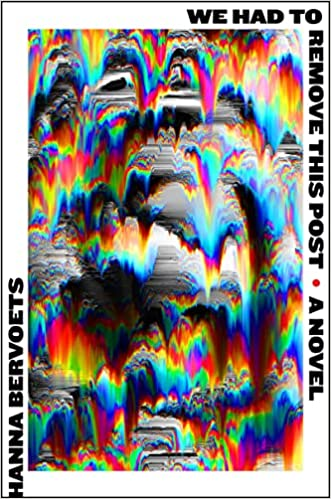
I am not one that looks up the artists of book covers very often, but June Park, the artist, deserves some attention. This could be the best cover of the decade.

I received this ARC from the publisher and NetGalley in exchange for an honest review.
Posted in fiction, Reviews | Tagged , , , , , | Leave a comment